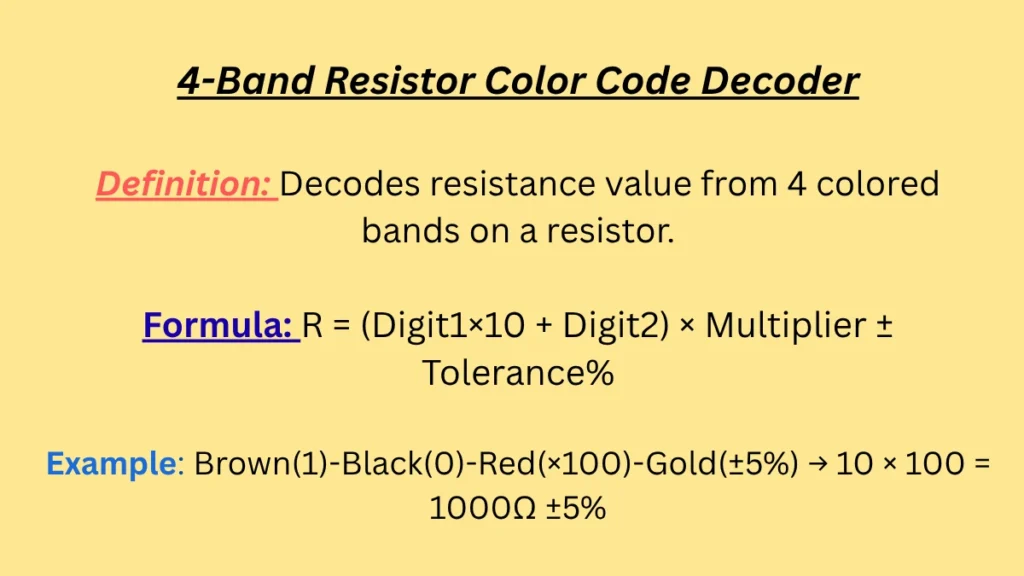
A 4-band resistor color code decoder converts colored band sequences into resistance values, tolerance percentages, and acceptable operating ranges. The first two bands encode significant digits. The third band specifies the multiplicative factor. The fourth band defines the tolerance.
The system follows IEC 60062. No measurement equipment is required for decoding. The color sequence alone provides the nominal resistance and its expected deviation.
4-Band Resistor Color Code Calculator
The calculator accepts four color inputs corresponding to the four band positions:
Band 1: first significant digit (10^1 place)
Band 2: second significant digit (10^0 place)
Band 3: multiplier (10^n where n is the multiplier value)
Band 4: tolerance (percentage deviation)
Selecting colors in sequence produces resistance in ohms (Ω), kilohms (kΩ), or megohms (MΩ). The tool also computes the tolerance interval.
Step-by-Step Calculation
How to Read a 4-Band Resistor
Identify the Reading Direction
The tolerance band usually sits farther from the other three. That gap tells you which end to start from. Gold and silver only appear in the fourth position, so spotting either color at one end confirms the reading direction.
Manufacturers don’t always leave a visible gap. When you can’t tell, compare the resistor to one with known values or check a reference image.
Read the First Two Bands
The first two bands give you the base number. The first band is the tens digit. The second is the ones digit.
Combined value = (digit_1 × 10) + digit_2
Brown followed by black gives you 10. Red followed by violet gives you 27.
Read the Multiplier Band
The third band scales the base number. The multiplier equals 10^n, where n comes from the color value.
| Color | Multiplier (Ω) |
|---|---|
| Black | 1 |
| Brown | 10 |
| Red | 100 |
| Orange | 1,000 |
| Yellow | 10,000 |
| Green | 100,000 |
| Blue | 1,000,000 |
| Gold | 0.1 |
| Silver | 0.01 |
Read the Tolerance Band
The fourth band tells you how far the actual resistance can stray from the nominal value. Tolerance appears as a percentage.
Common values:
Gold: ±5%
Silver: ±10%
No band: ±20%
Brown: ±1%
Red: ±2%
4-Band Resistor Color Code Chart
| Color | Digit | Multiplier (Ω) | Tolerance |
|---|---|---|---|
| Black | 0 | 1 | – |
| Brown | 1 | 10 | ±1% |
| Red | 2 | 100 | ±2% |
| Orange | 3 | 1,000 | – |
| Yellow | 4 | 10,000 | – |
| Green | 5 | 100,000 | ±0.5% |
| Blue | 6 | 1,000,000 | ±0.25% |
| Violet | 7 | 10,000,000 | ±0.1% |
| Grey | 8 | 100,000,000 | ±0.05% |
| White | 9 | 1,000,000,000 | – |
| Gold | – | 0.1 | ±5% |
| Silver | – | 0.01 | ±10% |
Gold and silver don’t have digit values. They only function as multipliers or tolerance indicators.
How to Calculate a 4-Band Resistor Value
Three steps get you the answer.
Step 1: Convert the first two bands to digits. Build the base integer:
Base = (10 × digit_1) + digit_2
Step 2: Find the multiplier from the third band. Compute nominal resistance:
R_nominal = Base × Multiplier
Step 3: Apply the tolerance percentage to find the range:
Deviation = R_nominal × (Tolerance / 100)
R_min = R_nominal – Deviation
R_max = R_nominal + Deviation
Work through brown, black, red, gold:
digit_1 = 1, digit_2 = 0
Base = (10 × 1) + 0 = 10
Multiplier = 100
R_nominal = 10 × 100 = 1,000 Ω
Tolerance = ±5%
Deviation = 1,000 × 0.05 = 50 Ω
R_min = 1,000 – 50 = 950 Ω
R_max = 1,000 + 50 = 1,050 Ω
4-Band Resistor Color Code Examples
Example 1: Red, Red, Orange, Silver
digit_1 = 2, digit_2 = 2
Base = 22
Multiplier = 1,000
R_nominal = 22 × 1,000 = 22,000 Ω = 22 kΩ
Tolerance = ±10%
Deviation = 22,000 × 0.10 = 2,200 Ω
R_min = 19,800 Ω
R_max = 24,200 Ω
Example 2: Yellow, Violet, Gold, Gold
digit_1 = 4, digit_2 = 7
Base = 47
Multiplier = 0.1
R_nominal = 47 × 0.1 = 4.7 Ω
Tolerance = ±5%
Deviation = 4.7 × 0.05 = 0.235 Ω
R_min = 4.465 Ω
R_max = 4.935 Ω
Example 3: Blue, Grey, Black, Brown
digit_1 = 6, digit_2 = 8
Base = 68
Multiplier = 1
R_nominal = 68 × 1 = 68 Ω
Tolerance = ±1%
Deviation = 68 × 0.01 = 0.68 Ω
R_min = 67.32 Ω
R_max = 68.68 Ω
Example 4: Brown, Green, Orange, Gold
digit_1 = 1, digit_2 = 5
Base = 15
Multiplier = 1,000
R_nominal = 15 × 1,000 = 15,000 Ω = 15 kΩ
Tolerance = ±5%
Deviation = 15,000 × 0.05 = 750 Ω
R_min = 14,250 Ω
R_max = 15,750 Ω
What Does Resistor Tolerance Mean?
Tolerance tells you the maximum percentage difference between the marked resistance and what you’ll actually measure. Manufacturing processes aren’t perfect. Every resistor varies slightly from its nominal value.
For a resistor with nominal resistance R and tolerance t, the actual resistance R_actual falls within:
R × (1 – t/100) ≤ R_actual ≤ R × (1 + t/100)
Common tolerance classes:
±5% (gold): general-purpose circuits
±10% (silver): less critical applications
±1% (brown): precision work
±2% (red): intermediate precision
When you test a resistor, check whether the measured value falls inside this range. If it doesn’t, either the component has drifted or your measurement setup has issues.
4-Band vs 5-Band Resistors
Four-band resistors give you two significant digits. Five-band resistors give you three. That extra digit means finer resolution.
| Parameter | 4-Band | 5-Band |
|---|---|---|
| Significant digits | 2 | 3 |
| Multiplier position | 3rd band | 4th band |
| Tolerance position | 4th band | 5th band |
| Typical tolerance range | ±5% to ±10% | ±0.1% to ±1% |
| Application context | General-purpose circuits | Precision measurement, instrumentation |
The nominal resistance for a 5-band resistor uses this formula:
R_nominal = [(100 × digit_1) + (10 × digit_2) + digit_3] × Multiplier
Count the bands before you decode. A 5-band resistor requires the 5-band method. Using a 4-band decoder on a 5-band resistor gives you the wrong value.
Common Mistakes When Reading Resistor Color Codes
Incorrect reading direction. The tolerance band sits at one end. Read from the opposite end. If you read backwards, the digits reverse and the value changes completely.
Confusing digits with multipliers. Black in the first position means zero. Black in the third position means multiply by 1. Brown in the first position means 1. Brown in the third position means multiply by 10. Position determines function.
Using gold or silver as digits. These colors don’t have digit values. They only show up in the multiplier or tolerance positions. If you see gold or silver in the first two bands, you’re reading from the wrong end.
Ignoring tolerance. The tolerance band defines the acceptable range. Without it, you can’t tell whether a measured value falls within specifications.
Misreading colors. Brown and red look similar in dim light. So do blue and violet, grey and white. Use bright light and keep a chart nearby.
Unit conversion errors. 1,000 Ω equals 1 kΩ. 1,000,000 Ω equals 1 MΩ. Mixing up units changes the magnitude of your value by factors of 1,000.
Frequently Asked Questions
How do you read a 4-band resistor?
Start from the end opposite the tolerance band. The first two bands are digits. The third is the multiplier. The fourth is tolerance.
What do the four bands on a resistor mean?
Band 1 is the first significant digit. Band 2 is the second significant digit. Band 3 is the multiplier. Band 4 is tolerance.
How do I calculate resistor value from color bands?
Combine the first two digits into a base number. Multiply by the multiplier from the third band. Apply tolerance to find the range.
What is the resistor color code for 1 kΩ?
Brown, black, red, gold. R = 10 × 100 = 1,000 Ω, tolerance ±5%.
What does the gold band mean on a resistor?
Gold in position 4 means ±5% tolerance. Gold in position 3 means multiplier = 0.1.
What does the silver band mean on a resistor?
Silver in position 4 means ±10% tolerance. Silver in position 3 means multiplier = 0.01.
What is resistor tolerance?
The maximum percentage deviation between nominal and actual resistance, expressed as ±t%.
What’s the difference between a 4-band and 5-band resistor?
Four-band resistors have two significant digits. Five-band resistors have three. The extra digit gives finer resolution.
How do I know which end of a resistor to read first?
Look for the tolerance band, usually gold or silver, and typically spaced farther from the others. Read from the opposite end.
Can a resistor color code decoder calculate the tolerance range?
Yes. It computes R_min = R_nominal × (1 – t/100) and R_max = R_nominal × (1 + t/100).
What resistor colors correspond to 2.2 kΩ?
Red, red, red, gold. R = 22 × 100 = 2,200 Ω, tolerance ±5%.
Are all 4-band resistors read the same way?
Yes. The standard follows IEC 60062. The decoding method stays consistent across manufacturers.