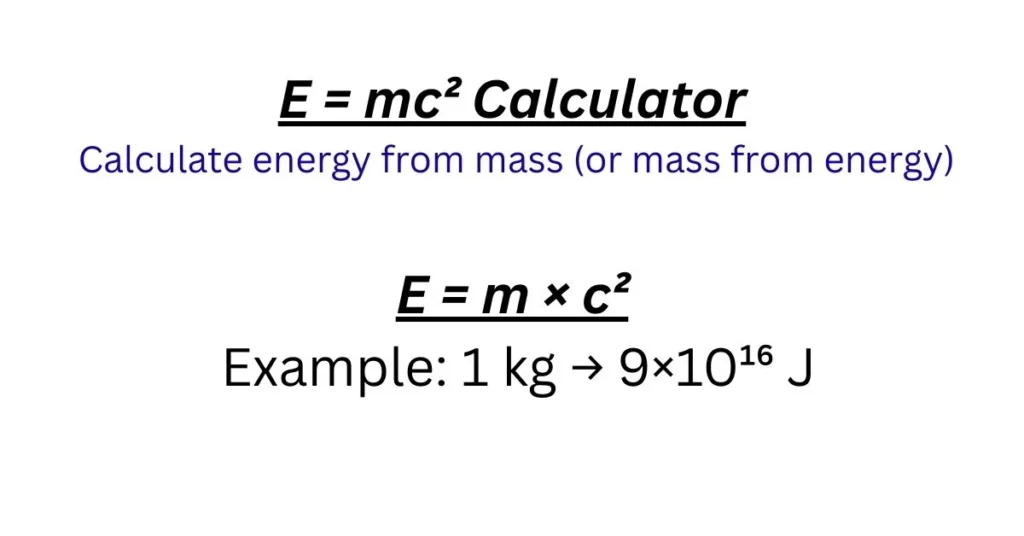
E = mc² Calculator
Calculate the energy equivalent of mass using Einstein's famous mass-energy equivalence formula. Enter the mass value and click Calculate to see the result.
E = mc² Calculator: Your Complete How-To Guide with Real Examples
Let me tell you about Sarah, one of my students last semester. She came to my office hours completely frustrated. “I can write E = mc² on paper,” she said, “but I don’t get what it actually means.” So I did what I always do—I pulled out my calculator and we started playing with numbers. An hour later, her face lit up. “Oh! Now I see it!” That moment is why I’m writing this guide for you today.
Whether you’re staring at a physics problem right now, studying for next week’s test, or just wondering what all the Einstein fuss is about, this guide will help. I’ve taught this material to thousands of students, and I know exactly where people get stuck. Let’s work through this together, with actual examples you can try yourself.
What Exactly Is This E = mc² Calculator?
Here’s the simplest way I can explain it: The E = mc² calculator is like a translator between mass and energy. You give it a weight (we’ll get to the mass vs. weight thing in a minute), and it tells you how much pure energy that represents.
Think of it this way—you know how you can exchange dollars for euros when you travel? The exchange rate tells you how many euros you get for your dollars. Well, E = mc² gives us nature’s exchange rate between mass and energy. The mass to energy calculator just does the math for you.
Who Needs This Calculator?
In my classroom, I see three types of students who really benefit from this physics homework calculator:
The Homework Hero: You’ve got problems due tomorrow and need to check your work. The calculator gives instant answers so you can focus on understanding, not arithmetic.
The Test Taker: You’re preparing for exams and need to build intuition. Playing with different numbers helps concepts stick better than just memorizing formulas.
The Curious Mind: You read about nuclear energy or black holes and want to understand the numbers behind the stories.
What Makes This Different From Regular Calculators?
Your phone’s calculator can multiply numbers. Our Einstein’s equation calculator does something more valuable—it helps you understand why the numbers matter. It shows you that 1 gram of anything contains more energy than you’d use in months, which changes how you see the world.
How to Use the E = mc² Calculator: A Step-by-Step Walkthrough
I’m going to walk you through this exactly like I do with my students during office hours. Grab your own calculator or use ours online as we go.
Step 1: Getting Your Mass Right
This is where most mistakes happen. The energy conversion calculator needs mass in kilograms. Not grams, not pounds—kilograms.
Quick Conversion Cheat Sheet:
Your smartphone: About 0.2 kg (200 grams = 0.2 kg)
A can of soda: About 0.355 kg
Your physics textbook: Usually 2-3 kg
You (average adult): 60-80 kg
Common Mistake I See: Students enter “1” for 1 gram instead of “0.001” for 0.001 kg. That makes their answer 1000 times too big! Always check: am I in kilograms?
Step 2: Understanding What Happens Inside
When you type in your number and hit calculate, here’s the magic:
The calculator grabs the speed of light: 299,792,458 meters per second
It squares that number (multiplies it by itself): 89,875,517,900,000,000
It multiplies your mass by that enormous number
It gives you the answer in joules
Why joules? That’s the standard energy unit. One joule lifts an apple about one meter. But with E = mc², we’re usually talking millions or billions of joules.
Step 3: Making Sense of the Answer
Big numbers are hard to understand. Good calculators (like ours) help by:
Using scientific notation (like 4.5 × 10^16 instead of 45,000,000,000,000,000)
Comparing to things you know (“equal to 10 Hiroshima bombs”)
Converting to better units when needed (terajoules instead of trillions of joules)
Real Examples You Can Try Right Now
Let’s work through actual problems together. These are exactly the types of questions I put on tests and homework.
Example 1: The Paperclip Problem
The Situation: A standard paperclip weighs about 1 gram. What’s its energy equivalent?
Let’s Solve It Together:
Convert to kg: 1 gram = 0.001 kg
Enter into our science calculator online: 0.001
Calculate
The Answer: About 9 × 10^13 joules
What This Really Means:
That tiny paperclip contains energy equal to about 20 kilotons of TNT—similar to the atomic bomb dropped on Nagasaki. Mind-blowing, right? This shows why nuclear weapons are so powerful: they release just a tiny fraction of the energy stored in matter.
Example 2: Textbook Energy (Common Homework Problem)
The Problem: “Calculate the energy equivalent of a 2.5 kg physics textbook.”
Step-by-Step Solution:
Mass is already in kg: 2.5
Use the student physics tool: Enter 2.5
Get result: 2.25 × 10^17 joules
Breaking It Down:
That’s 225,000,000,000,000,000 joules
Equal to about 50 megatons of TNT
Could power 6 million homes for a year (theoretically)
Why Teachers Give This Problem: It helps you grasp scale. Your textbook seems ordinary, but the energy it contains is astronomical.
Example 3: Human Body Calculation
Interesting Question: How much energy is in a 70 kg person?
Let’s Calculate:
Enter: 70 in the relativity calculator
Result: 6.3 × 10^18 joules
Perspective:
That’s 6.3 quintillion joules
Equal to 1.5 gigatons of TNT
More energy than all the nuclear weapons on Earth combined
Important Note: This is theoretical. We don’t have technology to convert people to energy (thankfully!), and even nuclear reactions only access about 0.1% of this.
Homework Help Section
Based on the questions students ask me most often, here are detailed solutions.
Problem Type 1: The Direct Calculation
Sample Question: “Find the energy in 0.03 kg of matter.”
My Teaching Method:
Identify: They want E, we have m = 0.03 kg
Formula: E = mc²
Calculation: Use the school physics calculator
Answer: 2.7 × 10^15 joules
Check: Does this make sense? For 0.03 kg (30 grams), yes—it’s huge but reasonable
Problem Type 2: The Comparison Question
Sample Question: “How does energy change if mass triples?”
Student Thinking Process:
Original: E = mc²
New mass: 3m
New energy: E_new = (3m)c² = 3 × (mc²) = 3E
Answer: Energy triples too
Why This Matters: The relationship is linear. Double mass = double energy. This is test-worthy knowledge.
Problem Type 3: The Real-World Application
Sample Question: “A nuclear reactor uses 1 kg of fuel per day. If 0.1% converts to energy, how much energy is produced?”
Stepwise Solution:
Total possible: Use nuclear energy calculator for 1 kg = 9 × 10^16 J
Actual: 0.1% = 0.001 × 9 × 10^16 = 9 × 10^13 J
Compare: That’s like 20,000 tons of TNT daily
Common Mistakes and How to Avoid Them
After fifteen years of teaching, I’ve graded enough papers to know exactly where students trip up.
Mistake 1: The Unit Mix-Up
The Error: “I entered 500 for my 500-gram phone and got a crazy answer.”
My Advice: Write “kg” next to every number. 500 grams = 0.5 kg. That visual reminder helps.
Mistake 2: The Scale Confusion
The Error: “9 × 10^16 doesn’t mean anything to me.”
Fix It: Use comparisons. Our calculator shows “equal to X Hiroshima bombs” or “could power Y homes.” Context matters.
Mistake 3: The “But I Can Use That Energy” Assumption
The Error: “If my phone has that much energy, why does the battery die?”
The Reality: The calculator shows theoretical maximum. Your phone battery uses chemical energy, which is millions of times weaker than nuclear energy.
Mistake 4: The Calculation Error
The Error: Manual mistakes in squaring 299,792,458
Solution: Use the calculator! That’s what it’s for. Even physicists use tools.
Study Strategies That Actually Work
From my experience helping students prepare for AP Physics, IB exams, and college courses:
For Visual Learners:
Make a chart on your wall:
Paperclip (1g): 9 × 10^13 J = Nagasaki bomb
Apple (150g): 1.35 × 10^16 J = Small earthquake
Textbook (2kg): 1.8 × 10^17 J = Volcanic eruption
Person (70kg): 6.3 × 10^18 J = All nukes on Earth
For Practice:
Do five calculations daily for a week. Start small, work up. The pattern will become intuitive.
For Test Prep:
Know these cold:
Speed of light: 3 × 10^8 m/s (approximation)
c²: 9 × 10^16 m²/s²
1 kg → 9 × 10^16 J
Advanced Applications for Curious Minds
Nuclear Power Understanding
When you read about nuclear plants, use the calculator to understand:
Why so little fuel? 1 kg uranium contains energy equal to 3 million kg of coal. The calculator shows why.
Safety perspective: Even “small” nuclear accidents involve tremendous energy. Calculate it to understand the scale.
Astronomy Connections
Stars shine by converting mass to energy. Our Sun converts 4 million tons to energy every second.
Try it: 4,000,000 tons = 4 × 10^9 kg
Calculate: 3.6 × 10^26 joules every second!
That’s why stars last billions of years.
Your Practice Problems
Try these—answers at the bottom:
Your coffee mug (0.4 kg with coffee) – Energy?
A baseball (0.145 kg) – How many homes could it power for a year?
If mass increases by 5×, energy increases by ____?
10 grams of matter – Compare to tons of TNT
Test Day Tips
The morning of your physics test:
Review conversions: grams to kg, know c = 3e8 m/s
Practice one problem: Build confidence
Remember: The calculator is your friend, not cheating
Check units: Every single time
During the test:
Read carefully: What are they really asking?
Estimate first: Should the answer be huge? Then check your work
Show steps: Even with calculator use, teachers want to see your thinking
Questions Students Actually Ask Me
“Do I need to memorize the speed of light?”
For tests, yes—3.00 × 10^8 m/s is usually fine. For homework, use the exact value your teacher gives.
“Why does this matter if we can’t use the energy?”
Two reasons: First, nuclear power uses a tiny fraction. Second, it helps us understand stars, the Big Bang, and the universe’s energy budget.
“How accurate is this calculator?”
Mathematically perfect for E = mc². But remember—it assumes 100% conversion, which doesn’t happen in reality.
“Can I use this for chemistry?”
No—chemical energy is about electron bonds, not mass conversion. The energies are much smaller.
“What’s the biggest thing I should calculate?”
Anything! But planets give numbers so large they’re hard to comprehend. Stick to everyday objects for learning.
Related Tools That Help
While you’re mastering E = mc², you might also need:
General Scientific Calculator – For other physics calculations
Unit Converter – For mass, energy, and other conversions
Periodic Table Tools – For understanding elements mentioned in nuclear contexts
Final Thoughts From a Teacher
When I see students really get E = mc², something changes. They start looking at ordinary objects differently. That paperclip isn’t just a paperclip—it’s a bundle of incredible potential energy. That understanding is what physics is really about.
The E = mc² calculator isn’t just for getting homework answers. It’s a window into one of the universe’s deepest truths: that mass and energy are fundamentally the same thing. Use it to explore, to question, to wonder.
Now go try it with something in your room. Start with your phone. Then your water bottle. See the patterns. That’s how you learn—not just by being told, but by discovering for yourself.
Practice Answers:
0.4 kg → 3.6 × 10^16 J (like 8 Hiroshima bombs)
0.145 kg → 1.3 × 10^16 J → about 350 homes/year
5× (linear relationship)
0.01 kg → 9 × 10^14 J → about 200 tons TNT