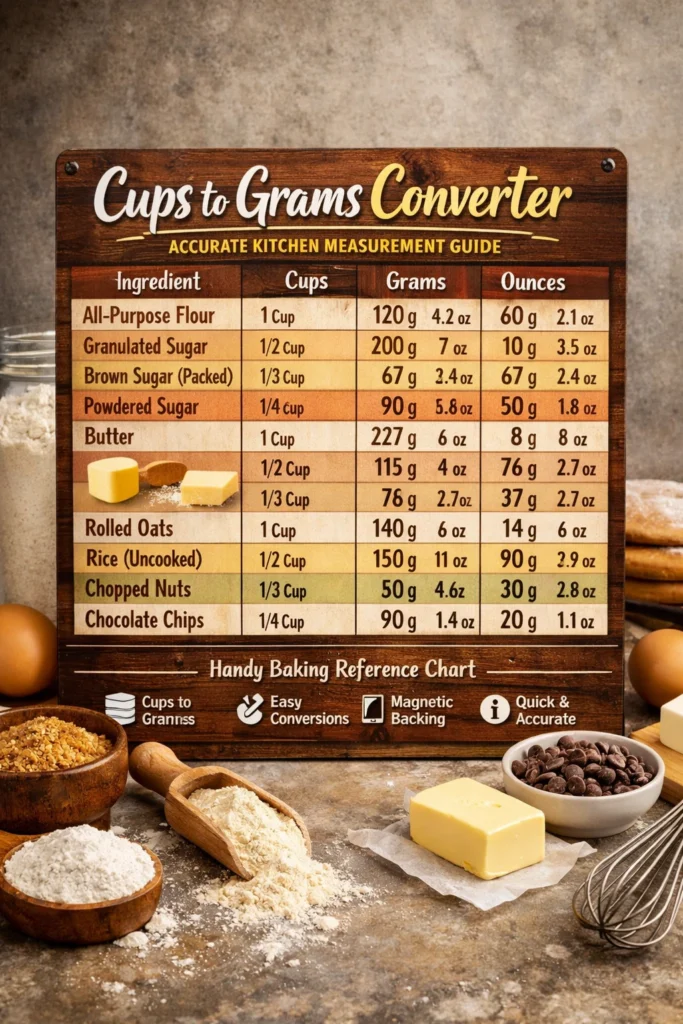
Cups to Grams Converter
Common Conversions
I’ll never forget my student, Maria. Every Tuesday, like clockwork, she’d bring in cookies. One week, they’d be perfect—golden, crisp-edged, and chewy-centered. The next? A single, sad puddle spread across the entire tray, or a batch so dry they crumbled to dust. The crazy part? She followed the same recipe to the letter every single time.
The problem wasn’t her effort or skill. It was that little white plastic cup in her hand. Depending on whether she scooped her flour lightly or packed it in, she was unknowingly adding anywhere from 120 to 150 grams of flour when the recipe called for a single “cup.” That 30-gram swing—the weight of a small egg—was the difference between triumph and disaster. The day I showed her a simple Cups to Grams Converter, it was like watching a lightbulb switch on. Her baking didn’t just improve; it transformed.
If your baking results feel like a lucky dip—sometimes great, sometimes a head-scratcher—you’re not alone. You’re running into the fundamental flaw of volume baking. A Cups to Grams Converter cuts through that guesswork. It translates the vague poetry of “a cup of flour” into the precise prose of “125 grams.” Whether you’re a home ec student, a bread-baking newbie, or just trying to make sense of your British aunt’s scone recipe, mastering this kitchen conversion is your first step toward baking accuracy you can actually rely on.
What a Cups to Grams Converter Actually Is
Here’s how I break it down for my classes: Think of it as your kitchen translator. Cups and grams are two different languages for describing amounts. Cups speak the language of space—“how much room does this take up?” Grams speak the language of weight—“how heavy is this actually?”
Let’s make it even simpler. Picture a one-cup measuring cup. Now, fill it with popcorn. Looks full, right? Now, empty it and fill it with marbles. Still one cup, but my goodness, it’s so much heavier. That’s your “aha!” moment. A cup of feather-light powdered sugar and a cup of dense, moist brown sugar take up the same space but have wildly different weights. A basic unit converter would treat them the same, but a proper Cups to Grams Converter knows better. It has the secret decoder ring, with different values for all-purpose flour (about 125g per cup), packed brown sugar (220g), or water (237g). It does the remembering for you, so your baked goods don’t pay the price.
How a Cups to Grams Converter Works in Your Kitchen
Let’s walk through it. You’ve got that classic chocolate chip cookie recipe open. It calls for 2 and a half cups of all-purpose flour. Here’s what happens:
You find your Cups to Grams Converter and select “All-Purpose Flour” from its list. It already knows the rule: 1 US cup = 125 grams.
You type in
2.5in the cup field.Faster than you can preheat your oven, it does the math: 2.5 x 125 = 312.5 grams.
But a good converter does more than just spit out a number. It might quietly tell you this assumes the “spoon and level” method—using a spoon to gently fill the cup, then sweeping a knife across the top. If you’d just dunked the cup into the flour bag, you’d have packed in maybe 140 grams, throwing everything off. This measurement tool handles the wet, the dry, and the sticky, from milk to honey to butter, each with its own conversion factor, turning recipe confusion into culinary precision.
Top Reasons to Use a Cups to Grams Converter
After fifteen years of teaching, I’ve seen the switch to grams change bakers’ lives. Here’s why it’s worth it:
Consistency Becomes Your Default Setting. Take David, another student. He was practicing his grandma’s biscuit recipe for a competition. Batch one: sublime. Batch two: hockey pucks. We converted his family recipe to grams. The very next batch—and every batch after—was identical. He took home a blue ribbon. Grams take the variability out of your hands and give you repeatable results.
Math Replaces Mystery. Need to halve a banana bread recipe? What’s “half of ⅓ cup of oil”? With grams, it’s clean, simple division. No more awkward eyeballing. This is essential for recipe scaling.
The Whole World’s Recipes Open Up. Fancy a Victoria Sponge from a British book (it’s in grams)? Or a skillet cookie from an American blog (in cups)? The Cups to Grams Converter is your passport. No more skipping amazing recipes because they use a different measurement system.
You Become a Baking Detective. When your cookies spread too much, you’ll know it’s not because you accidentally used too much butter—because you weighed exactly 227 grams. The problem must be oven temperature or dough warmth. This turns baking from magic into manageable, edible science.
Your Confidence Will Soar. I watch it happen every semester. The nervous hunch over a recipe relaxes. Students start understanding why a recipe works, tweaking it on purpose. The converter stops being a crutch and starts being a teacher for confident baking.
The Simple Formula Behind the Cups to Grams Converter
Don’t let the word “formula” scare you. This is simple kitchen math:
Grams = Your Number of Cups x Grams per Cup for That Ingredient
That’s it. The “Grams per Cup” bit is the key. It’s the density factor—brown sugar’s molasses makes it heavier; flour’s air pockets make it lighter. Your converter has a little database of these factors for all the common baking ingredients. It uses sensible averages (spooned flour, packed brown sugar) so you get a number that works in a real kitchen, not just in a math equation, ensuring recipe success.
Your Step-by-Step Guide to Using a Cups to Grams Converter
Ready to try? Follow these steps like I teach my beginners:
Pick Your Tool: Find a reputable Cups to Grams Converter online. A good one specifies “US cups” (236.6 ml), has a big list of ingredients, and mentions measurement standards.
Prep Your Station: Read your recipe all the way through. Gather your ingredients. Is your flour fluffy from the bag or compacted? This is part of mise en place.
Convert, One Line at a Time: Go ingredient by ingredient. Select, type, write down the gram weight right on your recipe. This is methodical preparation.
Measure with Your Scale: Bowl on scale. Press ‘Tare’ (or ‘Zero’). Add flour until you hit your number. Press ‘Tare’ again. This “tare” function is your best friend for precise weighing.
Learn and Adjust: Bake, then taste. Note if the dough felt too wet. Next time, maybe your brand of flour needs 5g less. This is how you develop baker’s intuition.
Practical Examples of a Cups to Grams Converter in Action
Scenario 1: Sarah’s Perfect Cookies.
Her recipe: 2¼ cups flour, 1 cup packed brown sugar, ¾ cup white sugar, 1 cup butter.
Her Cups to Grams Converter told her: 281g flour, 220g brown sugar, 150g white sugar, 227g butter.
The result? Bakery-quality cookies, every single batch. No more “did I pack the sugar enough?” angst.
Scenario 2: Michael Cracks the British Scone Code.
The recipe said: 225g flour, 50g butter, 25g sugar, 150ml milk.
He used the converter in reverse: 225g ÷ 125g/cup = ~1.8 cups flour. 50g butter ÷ 227g/cup = ~3.5 tbsp.
Suddenly, the international recipe made perfect sense with his American tools.
Scenario 3: Jessica Halves Her Banana Bread Without the Headache.
Full recipe: 2 cups flour (250g), 1 cup sugar (200g), ½ cup oil (109g).
Half recipe: 125g flour, 100g sugar, 55g oil.
Weighing 55 grams of oil is simple. Measuring “a quarter cup plus a smidge” is not.
Essential Charts for Your Cups to Grams Converter Reference
Keep these tables handy. They show why a one-size-fits-all conversion doesn’t work and how a proper Cups to Grams Converter delivers accurate measurements.
Common Dry Ingredient Conversions
| Ingredient | 1 Cup (US) in Grams | Notes for Best Results |
|---|---|---|
| All-Purpose Flour | 125 g | Spoon & level for accuracy |
| Bread Flour | 136 g | Higher protein, more dense |
| Cake Flour | 114 g | Finely milled, lighter |
| Granulated Sugar | 200 g | Spooned into cup, not packed |
| Packed Brown Sugar | 220 g | Must be firmly packed |
| Powdered Sugar | 120 g | Sifted before measuring |
| Rolled Oats | 90 g | Light and fluffy |
Common Wet & Fat Ingredient Conversions
| Ingredient | 1 Cup (US) in Grams | Notes for Best Results |
|---|---|---|
| Water / Milk | 240 g | Measured at eye level in liquid cup |
| Honey / Syrup | 340 g | Coat cup with oil for clean release |
| Vegetable Oil | 218 g | Slightly less dense than water |
| Melted Butter | 227 g | 1 cup = 2 sticks = 227g exactly |
| Sour Cream / Yogurt | 245 g | Thick, similar density to milk |
| Heavy Cream | 235 g | Slightly lighter than milk |
Common Mistakes to Avoid With Your Cups to Grams Converter
I’ve seen every error in the book. Learn from them:
The Generic Select: Picking “flour” when you have “bread flour” adds extra protein and weight, leading to tough dough. Be specific with your ingredient selection.
The Wrong Cup: Using a dry measuring cup for milk shortchanges you liquid. Use proper liquid measures for wet ingredients.
The Forgotten Tare: Not zeroing the scale between ingredients is the #1 scale mistake. Tare. Every. Time. This is scale accuracy 101.
Ignoring Recipe Origin: An Australian cup is 250ml, a US cup is 237ml. That 5% matters in precision baking. Know your recipe’s origin.
Over-Rounding: Rounding 312.5g to 300g throws your ingredient ratios off. Round to the nearest 1-5 grams max.
The golden rule? The Cups to Grams Converter gives you measurement precision, but you bring the baking judgment. Your senses and your scale are a powerful team for dough consistency.
Understanding the Limits of a Cups to Grams Converter
Let’s be straight. This tool is a game-changer, but it’s not a wizard.
What it’s brilliant at: Giving you a rock-solid, consistent starting point. It eliminates the biggest variable—your scoop—and makes recipe scaling a breeze for home cooking and professional baking.
Where it needs your help:
Your Ingredients Vary: Fancy flour vs. store brand have slightly different ingredient densities. The converter gives an average; you make the tiny tweak.
Your Kitchen Environment: Baking in high altitude or humidity? The standard conversion is your starting line. Adjust based on dough feel.
Heirloom Recipes: Grandma’s cookie recipe probably assumed a heavy scoop. You might need to nudge the converted number up for authentic results.
Advanced Projects: Making sourdough bread or French macarons? You’ll need recipe-specific gram weights for perfect hydration.
A Cups to Grams Converter is your indispensable kitchen ally for food preparation. It hands you control over the one thing in baking you can truly control. The rest—the baking technique, the timing, the joy—is still wonderfully up to you.
Now, go find that recipe that never quite worked and give it one more try—this time, by weight. I think you’ll be amazed at the difference. Happy baking!