Euclid's Algorithm Calculator
Find the Greatest Common Divisor (GCD) of two numbers using Euclid's Algorithm
Calculation Result
For numbers 0 and 0:
Elastic Potential Energy Calculator | Easy Spring Energy Tool
What Is Elastic Potential Energy?
Elastic potential energy is stored energy in stretched or compressed objects. When you pull a rubber band, push a spring, or bend a diving board, you’re storing elastic potential energy. This energy comes from the work you do to change the object’s shape. When you let go, that stored energy converts into motion.
I remember teaching this to my 9th grade science class last year. We used simple slinkies to demonstrate. When you stretch a slinky and hold it, your arms get tired. That’s because you’re constantly supplying energy to keep it stretched. That energy isn’t disappearing—it’s being stored in the slinky itself. The moment you let go, whoosh—all that stored energy converts back to motion.
Understanding the Elastic Potential Energy Calculator
What This Calculator Does
The Elastic Potential Energy Calculator is a straightforward tool that handles the math for spring energy problems. You give it two numbers, it gives you one useful answer.
You put in:
-
Spring stiffness (k): Called the “spring constant,” measured in N/m. Higher number = stiffer spring.
-
Stretch distance (x): How far you pull or push the spring from its normal length, in meters.
You get out:
-
Stored energy (PE): The elastic potential energy in Joules.
Real Example from My Classroom
Last month, my students were building marble launchers for a physics project. Jamal had a spring with stiffness k = 85 N/m. He wanted to know how much energy he’d store if he pulled it back 12 cm.
The problem: 12 cm needs to be meters first. That’s 0.12 m.
Using the calculator: Enter k = 85, x = 0.12
Result: 0.612 Joules of stored energy
That number told Jamal exactly how much “launch power” he had. He could then calculate how fast his marble would fly using conservation of energy principles.
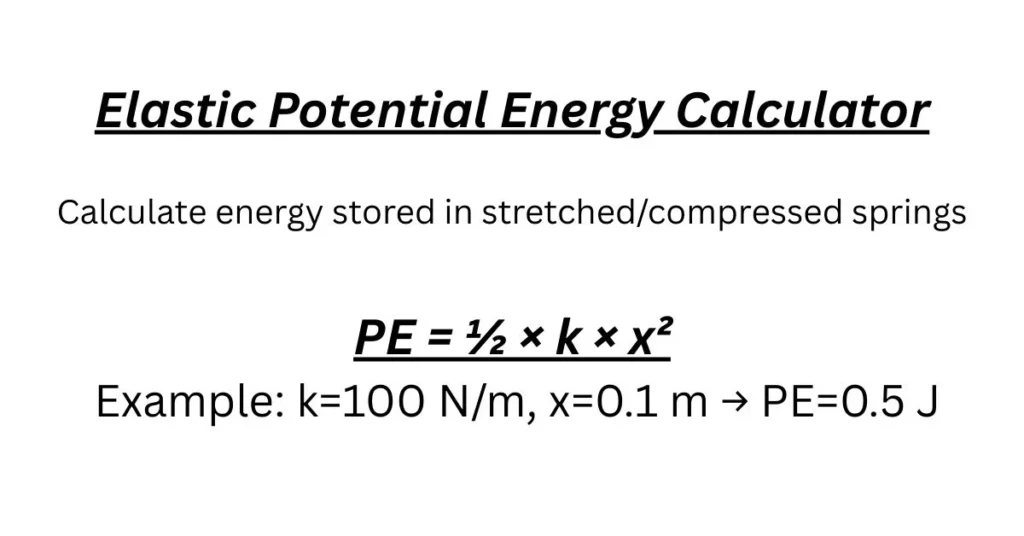
The Formula: PE = ½ k x²
Breaking It Down Simply
PE = Elastic Potential Energy (Joules)
k = Spring constant (N/m)
x = Displacement – how far stretched/compressed (meters)
½ = One-half – accounts for average force
Why This Formula Works
Let me explain this like I do to my students. When you stretch a spring slowly:
-
First inch: Easy, little force needed
-
Last inch: Hard, lots of force needed
The force isn’t constant—it increases as you stretch. The ½ comes from using the average force. If you graph force versus stretch, you get a triangle. The area of that triangle (which represents work done = energy stored) is ½ × base × height.
The x² part is crucial. It means energy increases with the SQUARE of the stretch.
Double the stretch = FOUR times the energy
This explains why pulling a slingshot just a bit farther makes a big difference.
Real Examples Using the Calculator
Example 1: Homework Problem
*Find energy stored in spring with k = 200 N/m stretched 0.15 m.*
Calculator steps:
-
k = 200
-
x = 0.15
-
Click calculate
-
Result: 2.25 J
What this means: You’ve stored enough energy to lift a 1 kg weight about 23 cm off the ground.
Example 2: Car Suspension
*A car’s suspension spring (k = 25,000 N/m) compresses 0.06 m over a bump.*
Calculator:
k = 25000, x = 0.06
Result: 45 Joules
Real-world significance: Each wheel spring absorbs 45 J from that bump. A car hitting a series of bumps might have its suspension handling thousands of Joules per minute!
Example 3: DIY Project
*Building a simple trigger mechanism that needs 1.5 J of energy. You have a spring with k = 75 N/m. How far to compress it?*
Working backwards:
We know: 1.5 = ½ × 75 × x²
1.5 = 37.5 × x²
x² = 1.5 ÷ 37.5 = 0.04
x = √0.04 = 0.2 m (20 cm)
Design answer: Compress the spring 20 cm to get your 1.5 J.
Common Questions About Elastic Potential Energy
“What’s a normal spring constant value?”
-
Pen spring: ~1-5 N/m
-
Slinky: ~0.5 N/m
-
Car suspension: ~20,000 N/m
-
Industrial springs: Up to 100,000+ N/m
“My answer seems wrong. What should I check?”
-
Did you convert cm to m? 5 cm = 0.05 m, not 5
-
Did you square the distance? (0.1)² = 0.01, not 0.2
-
Did you use the right k value? Check your problem again
“Does compression use different math than stretching?”
No. The formula works the same. Compression just means x is in the opposite direction, but x² is always positive.
“How accurate is the calculator?”
It’s mathematically perfect for the formula. But real springs aren’t perfect—they have limits. If you stretch a spring too far, it won’t spring back completely. The calculator doesn’t know this physical limit.
“Can I use this for rubber bands?”
Yes, but rubber bands don’t always follow the perfect spring law. Results will be approximate.
“What if I don’t know the spring constant?”
Find it experimentally:
-
Hang a known weight (creates force F)
-
Measure how far spring stretches (x)
-
Calculate k = F ÷ x
“Why Joules? What does 1 Joule feel like?”
1 Joule = energy to lift a medium apple about 1 meter. It’s a handy real-world reference.
“What’s the difference between this and gravitational potential energy?”
-
Elastic: Energy from shape change (springs, rubber bands)
-
Gravitational: Energy from height (book on shelf, water behind dam)
“How does temperature affect spring energy?”
Very cold: Springs get slightly stiffer (k increases slightly)
Very hot: Springs get slightly softer (k decreases slightly)
“Can elastic potential energy be negative?”
No. Energy is “how much,” not “which way.” x² is always positive, so PE is always positive or zero.
“What if I use two springs together?”
-
Side by side (parallel): Effective k = k₁ + k₂
-
End to end (series): Effective k = 1/(1/k₁ + 1/k₂)
“Where does the energy go when released?”
It converts to:
-
Motion (kinetic energy)
-
Heat (from friction)
-
Sound (the “boing” of a spring)
“Is there a maximum energy a spring can store?”
Yes. Every spring has an elastic limit. Stretch beyond this, and it won’t return to original shape. The calculator doesn’t warn you about this.
“How precise should my answer be?”
Use 2-3 significant figures usually. If inputs are k=120 (3 figures) and x=0.25 (2 figures), your answer should have 2 figures.
“What tools help with related calculations?”
-
Hooke’s Law calculator (F = kx for force)
-
Kinetic energy calculator (½mv² for motion energy)
-
Simple harmonic motion calculators for bouncing springs
When to Trust (and Not Trust) Your Results
Trust the calculator for:
-
Homework verification
-
Science project planning
-
Understanding concepts
-
Design estimations
Don’t trust it blindly for:
-
Safety-critical applications
-
Precision engineering
-
Springs near their limits
-
Unusual materials
The Elastic Potential Energy Calculator is an excellent learning tool. It handles the math perfectly so you can focus on the physics. But always remember: real springs have real limits that formulas can’t capture.
Try It Yourself
Grab your calculator and test this:
Use k = 100, x = 0.1 → You get 0.5 J
Now change only x to 0.2 → You get 2.0 J
See how doubling stretch quadruples energy?