Diamond Problem Solver
Solve quadratic equations using the diamond method. Enter the sum and product to find the two numbers.
Solution
Diamond Problem Solver: Let's Actually Make Sense of This Together
What Is a Diamond Problem Solver?
Okay, let’s be real for a minute. You’re looking at something like x² + 7x + 12, and your teacher says, “Find two numbers that multiply to 12 and add to 7.” You’re probably thinking, “Great. Guess and check. Do I try 6 and 2? No, that’s 8. 4 and 3? That’s 7! Wait, but 4 times 3 is 12? Yes!”
That relief when you find it? That’s what our Diamond Problem Solver is here for—but not just to give you the answer. I want to help you feel that “aha!” moment more often, with less frustration. I’ve taught algebra to hundreds of students, and I promise you: everyone struggles with these at first. It’s normal. Today, I’m going to walk you through exactly how to think about these problems, and how this little calculator can become your secret weapon for actually understanding what’s going on.
Understanding the Diamond Problem Method: Breaking Down the Basics
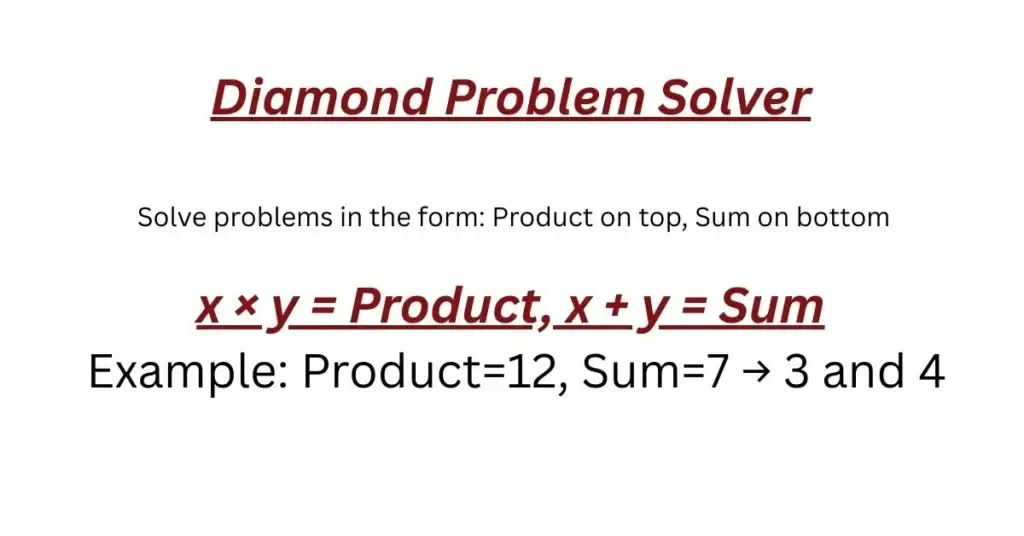
Let me put this in the simplest way I know: The Diamond Problem Solver helps you find mystery numbers when you know what they add up to and what they multiply to.
Picture this: You’re trying to crack a combination lock. You know the two numbers add up to 15, and when you multiply them, you get 56. What are they? That’s exactly what a diamond problem is—just with more x’s and parentheses in math class.
You’ll need this when:
Your homework says “factor completely” and you’re staring at a quadratic
You have a word problem about finding two numbers
You’re preparing for a test and want to check your work
You just want to understand why some numbers work together and others don’t
Here’s what makes our Diamond Problem Solver different: It doesn’t just spit out numbers. It shows you the relationship. It’s like having a patient tutor who says, “Look, 7 and 8 work because 7+8=15 and 7×8=56. See how that fits together?”
When I was learning this, I wish I had something that showed me the connections instead of just giving me answers. That’s why I helped create this tool—to give you what I needed back then.
How to Use the Diamond Problem Solver: Step-by-Step Guide
Here’s exactly what happens when you use this—no math jargon, I promise:
You tell the calculator two things:
“Hey, my two mystery numbers add up to _____” (that’s your sum)
“Oh, and when I multiply them, I get _____” (that’s your product)
Then the calculator does the detective work for you:
It finds those two numbers that fit both clues
It shows you a little diamond diagram so you can see how everything connects
It proves to you that the numbers actually work (no trick answers here)
It even shows you how to write the factored form of your quadratic equation
For example, if you’re looking at x² + 9x + 20 and you’re stuck, you’d enter sum = 9 and product = 20. The calculator comes back with: “Try 5 and 4.” And then it shows you: 5 + 4 = 9 ✓ and 5 × 4 = 20 ✓. That means you can write (x + 5)(x + 4) with confidence.
Real-Life Applications of the Diamond Method
Let me tell you why my students actually use this thing—not because I tell them to, but because it helps in real ways.
First: The midnight homework panic. It’s 10 PM, you’ve got three more algebra problems, and you’re stuck on x² + 11x + 24. You’re trying numbers in your head: “6 and 5? That’s 11 but 30… 8 and 3? That’s 11 and 24! Wait, 8 times 3 is 24? Yes!” But what if it were x² + 13x + 40? That takes longer. The calculator gives you that answer quickly so you can move on with your life.
Second: Building confidence. There’s nothing worse than doing a whole page of factoring, then wondering if you’re even right. With this, you can check your work instantly. Did you get 4 and 7 for sum 11, product 28? Check it. 4+7=11 ✓, 4×7=28 ✓. Good! Move to the next one with confidence.
Third: Seeing patterns. When you use the calculator a few times, you start noticing things. Like when the product is positive but the sum is negative, both numbers must be negative. Or when the product is negative, one’s positive and one’s negative. These patterns stick better when you see them work multiple times.
Fourth: Test anxiety relief. Before a big test, my students use this to practice. They solve problems by hand, then check with the calculator. It’s like having a study buddy who never gets tired of checking your work.
Diamond Problem Formula Explained Simply
Alright, let’s get into the formula, but I’m going to explain it in a way that actually makes sense. Remember, this isn’t magic—it’s just organized thinking.
Let’s say our two mystery numbers are a and b. We know:
a + b = S (that’s our sum, what they add to)
a × b = P (that’s our product, what they multiply to)
Here’s the cool part: a and b are actually the solutions to this equation:
x² – Sx + P = 0
Why? Let me show you with our earlier example where S=7 and P=12. If we write (x – a)(x – b) and multiply it out:
First: x × x = x²
Outer: x × (-b) = -bx
Inner: (-a) × x = -ax
Last: (-a) × (-b) = ab
Put it together: x² – bx – ax + ab = x² – (a+b)x + ab
See? a+b shows up as the coefficient of x (with a minus sign), and ab shows up as the constant. That’s why knowing the sum and product tells you everything!
Now, to find a and b from S and P, we use:
a, b = [S ± √(S² – 4P)] ÷ 2
Let me break this down like we’re solving a puzzle:
S² – 4P is called the “discriminant” (fancy word for “the thing under the square root”)
If it’s positive → we get two different real numbers
If it’s zero → we get the same number twice (like 4 and 4)
If it’s negative → no real numbers work (calculator will tell you this)
The ± means we do both “plus the square root” and “minus the square root”
Then we divide by 2 to get our final numbers
Solving Diamond Problems Step-by-Step
Let’s walk through exactly what happens with a problem you might actually see on homework. Let’s say you’re factoring x² – 5x – 14.
Step 1: Figure out what to enter
First, you need to know: In x² – 5x – 14, what’s the sum? It’s -5 (not 5—watch that negative!). What’s the product? It’s -14. So you’d enter: Sum = -5, Product = -14.
Step 2: Inside the calculator’s brain
The calculator thinks: “Okay, S = -5, P = -14. Let’s calculate S² – 4P.”
That’s (-5)² – 4(-14) = 25 – (-56) = 25 + 56 = 81.
Step 3: Take the square root
√81 = 9 (nice and clean)
Step 4: Apply the formula
First number = (-5 + 9) ÷ 2 = 4 ÷ 2 = 2
Second number = (-5 – 9) ÷ 2 = (-14) ÷ 2 = -7
Step 5: Check it makes sense
The calculator verifies: 2 + (-7) = -5 ✓ and 2 × (-7) = -14 ✓
Step 6: Show you the factored form
Since we got 2 and -7, the factored form is (x + 2)(x – 7). But wait—let me explain why it’s minus 7, not plus: Because if a = 2, then (x – a) = (x – 2)? No, that doesn’t match. Actually, let me clarify this important point…
Common Diamond Problem Examples from Real Homework
Let me show you three examples from actual worksheets I’ve given my students:
Example 1: The classic “nice numbers” problem
Problem: Factor x² + 8x + 15
What you do: Sum = 8, Product = 15
Calculator shows: 3 and 5
Why? Because 3+5=8 and 3×5=15
Factored form: (x+3)(x+5)
Example 2: When both numbers are negative
Problem: Factor x² – 9x + 20
What you do: Sum = -9, Product = 20
Calculator shows: -4 and -5
Check: (-4)+(-5)=-9 ✓, (-4)×(-5)=20 ✓
Factored form: (x-4)(x-5)
Example 3: Tricky with opposite signs
Problem: Factor x² + 2x – 15
What you do: Sum = 2, Product = -15
Calculator shows: 5 and -3
Check: 5+(-3)=2 ✓, 5×(-3)=-15 ✓
Factored form: (x+5)(x-3)
Visualizing Diamond Problems: The Diamond Diagram
Our calculator includes a diamond diagram because some people just “get” things better when they see them. Here’s how to read it:
      Sum
      (8)
     /   \
    /     \
   ?       ?
  /         \
 /           \
Product      Product
(15)        (15)
When you put numbers in:
      8
     / \
    /   \
   3     5
  /       \
 /         \
15         15
The visual shows you that 3 and 5 go on the sides, 8 goes on top (their sum), and 15 goes on bottom (their product). Seeing this relationship helps it click for visual learners.
Common Mistakes with Diamond Problems (And How to Avoid Them)
Over the years, I’ve seen students make the same mistakes. Let me save you the trouble:
Mistake 1: Sign confusion
“My calculator says 3 and 4, but my answer should be (x-3)(x-4), not (x+3)(x+4)!”
Fix: Remember, if your sum was NEGATIVE, your factors need minus signs. If sum = -7 and product = 12, you get -3 and -4, so (x-3)(x-4).
Mistake 2: Forgetting to check both conditions
“I found numbers that multiply right, but they don’t add right!”
Fix: Always check BOTH the sum AND product. The calculator does this automatically.
Mistake 3: Giving up on decimals
“It gave me decimals! I must have done something wrong.”
No! Some quadratics don’t factor nicely with integers. x² + 3x + 1 factors to (x+2.618)(x+0.382). Decimals are valid answers.
Mistake 4: Misreading the problem
“I entered 5 for the sum, but it should have been -5!”
Fix: Slow down. If your quadratic is x² – 5x + 6, the sum is -5, not 5.
Advanced Diamond Problem Techniques
Once you’re comfortable with the basics, here are some patterns to notice:
Pattern 1: Perfect square trinomials
When S² = 4P, you get the same number twice.
Example: x² + 6x + 9 → sum=6, product=9 → 3 and 3 → (x+3)²
Pattern 2: Difference of squares
When S=0 and P is negative, you get opposites.
Example: x² – 25 → sum=0, product=-25 → 5 and -5 → (x+5)(x-5)
Pattern 3: When product = 0
If P=0, one number is 0, the other equals the sum.
Example: x² + 7x → sum=7, product=0 → 0 and 7 → x(x+7)
Diamond Problem Calculator Accuracy and Limitations
Let me be honest about what this calculator can and can’t do:
What it does well:
Gives exact answers for integers and simple fractions
Handles decimals up to 15 decimal places of precision
Works for any real numbers you’ll encounter in algebra class
Shows you the thinking process
Limitations to know about:
It only finds real number solutions. If the discriminant is negative, it’ll say “no real solution.”
It assumes the x² coefficient is 1. For 2x² + 8x + 6, divide by 2 first to get x² + 4x + 3.
Extremely large numbers (like 10¹⁵) might have rounding issues, but you won’t see those in school.
When to double-check:
On high-stakes tests (practice with it, but be ready to solve manually)
When the answer seems obviously wrong (check your inputs)
When working with fractions (convert to decimals or use exact mode if available)
Frequently Asked Questions About Diamond Problems
Here are real questions my students ask—and my honest answers:
1. “What if my diamond problem calculator says no real solution?”
That means the discriminant (S² – 4P) is negative. In plain English: No real numbers exist that satisfy both conditions. For example, sum=1, product=10 gives discriminant = 1-40 = -39. No real numbers add to 1 and multiply to 10.
2. “How do I solve diamond problems with fractions?”
Enter them as decimals, or find a common denominator first. For sum=1/2, product=1/3, enter 0.5 and 0.333. The calculator handles decimals fine.
3. “Can I use the diamond method for 2x² + 8x + 6?”
Yes, but divide everything by 2 first: x² + 4x + 3. Then use sum=4, product=3. You get 1 and 3, so factors are (x+1)(x+3). Don’t forget the 2: 2(x+1)(x+3).
4. “Why is it called a diamond problem?”
Because of the visual: sum on top, product on bottom, two numbers on the sides—it looks like a diamond!
5. “My teacher says show your work. Can I use the calculator?”
For homework practice, absolutely. For tests, probably not. Use it to check your work while studying, but practice solving by hand too.
6. “What’s the fastest way to solve diamond problems without a calculator?”
For integers, think of factor pairs of the product, then check which pair adds to the sum. For 12: 1×12, 2×6, 3×4. Which adds to 7? 3+4=7.
7. “How do negative numbers work in diamond problems?”
Positive product, positive sum: both numbers positive
Positive product, negative sum: both numbers negative
Negative product: one positive, one negative
8. “What if I get decimals like 2.618 and 0.382?”
Those are valid! They’re actually (1+√5)/2 and (1-√5)/2, related to the golden ratio. Some quadratics don’t factor with nice integers.
9. “Can the diamond method solve x² = 9?”
That’s x² – 9 = 0, so sum=0, product=-9. Numbers are 3 and -3: (x+3)(x-3)=0.
10. “How accurate is the diamond problem solver?”
Very. It uses double-precision arithmetic (about 15 decimal places). For schoolwork, that’s more than enough.
11. “What’s the largest number I can enter?”
Anything you’d see in algebra class works fine. Theoretically, numbers around 10¹⁵ might have precision issues, but you’ll never see those.
12. “Why do I sometimes get the same number twice?”
That’s a perfect square trinomial. Example: x² + 6x + 9 → sum=6, product=9 → 3 and 3 → (x+3)².
13. “Can I use this for word problems?”
Yes! “Find two numbers whose sum is 10 and product is 24” is a direct diamond problem.
14. “How do I check if my diamond problem answer is correct?”
Multiply your factors back out. (x+3)(x+4) = x² + 7x + 12. If that matches your original, you’re right.
15. “What if the x² coefficient isn’t 1?”
Divide everything by that coefficient first. 2x² + 10x + 12 → divide by 2 → x² + 5x + 6 → solve normally → 2(x+2)(x+3).
16. “Do I always get two different numbers?”
No, sometimes you get the same number twice (perfect squares).
17. “Can the diamond method find complex numbers?”
This calculator doesn’t show complex numbers, but mathematically, yes—when the discriminant is negative, the solutions are complex.
18. “How do I handle really large products?”
The calculator handles them fine. If doing by hand, look for obvious factor pairs first.
19. “What’s the connection to the quadratic formula?”
The diamond method IS the quadratic formula in disguise, just starting from sum and product instead of a, b, c.
20. “Why learn this if I have a calculator?”
Understanding builds number sense and helps in more advanced math. Plus, tests often require showing work.
Practice Problems for the Diamond Problem Solver
Try these with our calculator:
x² + 10x + 21 = 0
x² – 3x – 10 = 0
x² + x – 12 = 0
x² – 8x + 16 = 0
x² + 5x + 6 = 0
Answers: 1) (x+3)(x+7) 2) (x-5)(x+2) 3) (x+4)(x-3) 4) (x-4)² 5) (x+2)(x+3)
Related Math Tools You Might Find Helpful
Once you’ve mastered diamond problems, you might want to explore:
Quadratic Formula Calculator – For when you need to solve ax²+bx+c=0 directly
Factoring Calculator – Handles more complex factoring beyond basic quadratics
Polynomial Roots Finder – For higher-degree polynomials
Each tool has its place, but the Diamond Problem Solver is perfect for building that foundational understanding of how numbers relate in quadratic equations.
Final Thoughts from a Teacher Who Cares
Look, I know algebra can feel like a mystery sometimes. All these x’s and parentheses and rules. But here’s the secret: It’s just patterns. The diamond problem shows you one of the most beautiful patterns in algebra—how addition and multiplication connect in quadratic equations.
Our Diamond Problem Solver isn’t here to do your homework for you. It’s here to show you the patterns, to build your confidence, to help you understand. Use it when you’re stuck. Use it to check your work. Use it to see what happens when you change numbers around.
But also, try solving some problems by hand. Feel that satisfaction when you find the numbers yourself. Notice how you start recognizing patterns faster each time. That’s the real goal—not just getting answers, but understanding why they work.