Euclid's Algorithm Calculator
Find the Greatest Common Divisor (GCD) of two numbers using Euclid's Algorithm
Calculation Result
For numbers 0 and 0:
Euclid's Algorithm Calculator: Find Greatest Common Divisor Instantly
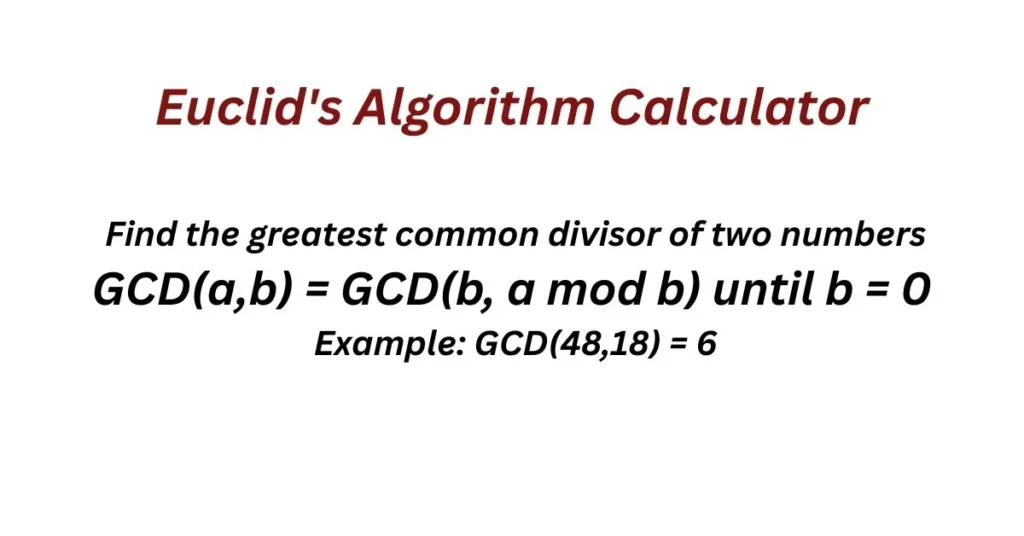
I remember the first time I tried simplifying the fraction 48/64. I sat there, listing factors of 48… 1, 2, 3, 4, 6, 8, 12, 16, 24, 48. Then factors of 64… 1, 2, 4, 8, 16, 32, 64. Finally, comparing lists to find the largest common number. It took me almost ten minutes, and honestly? I wasn’t even sure I hadn’t missed something.
There’s a better way. And it’s been around for over two thousand years.
If you’re tired of the factor-list dance or just need to get through your math homework without the headache, let me introduce you to a tool that became my secret weapon as both a student and later as a teacher: the Euclid’s Algorithm Calculator.
What Is This Calculator, Really? | Understanding the GCD Finder
Here’s the simplest way to understand it: The Euclid’s Algorithm Calculator is like a math tutor who shows their work.
You know how frustrating it is when you get a wrong answer on homework and have no idea where you messed up? This tool doesn’t just spit out a number. It walks you through the entire process of finding the Greatest Common Divisor (GCD) step-by-step.
Here’s what that means for you:
Stuck on simplifying fractions? It finds the number to divide by.
Need to split things evenly? It finds the largest fair share.
Studying number theory? It demonstrates the algorithm clearly.
I’ve recommended this to students who were ready to give up on fractions. Watching the calculator work through problems like 84/105 or 252/168 gave them the “aha!” moment they needed. It turns a confusing concept into something visible and traceable.
How to Use the Euclid’s Algorithm Calculator | Step-by-Step GCD Calculator Guide
Don’t worry about complicated settings or confusing menus. Using this calculator is straightforward:
Type your first number into the box labeled “First Number”. Let’s say you put
48.Type your second number into the next box. Let’s put
18.Click the “Calculate GCD” button.
That’s it. In less time than it takes to read this sentence, you’ll see two things:
The Answer: The Greatest Common Divisor (in this case, 6).
The Journey: A clean list showing every single calculation the algorithm performed to get there.
You’ll see something like:
*Step 1: 48 ÷ 18 = 2, remainder 12*
*Step 2: 18 ÷ 12 = 1, remainder 6*
*Step 3: 12 ÷ 6 = 2, remainder 0*
*GCD = 6*
Seeing those steps is powerful. It’s no longer magic; it’s method. You can use that same method on a test, even without the calculator.
Why Use a GCD Calculator? | Benefits of Online Euclidean Algorithm Tool
I get it. For small numbers like 12 and 15, you can probably figure out the GCD (it’s 3) in your head. The real value of this tool shows up in three common situations:
1. The “Homework Is Taking Forever” Scenario
It’s 10 PM. You have a worksheet with 15 fraction simplification problems. The last one is 252/378. Your brain is tired. Listing all factors of 252 and 378 feels impossible. This calculator gives you the answer (126) and shows you the work in seconds, so you can finish up and get some sleep.
2. The “I Have No Idea If I’m Right” Scenario
You solved a problem and got a GCD of 21, but the back of the book says 7. Where did you go wrong? Instead of redoing everything, plug the numbers into the calculator. Follow its steps and compare them to yours. You’ll spot your mistake (maybe you missed a factor of 3) and actually learn from it.
3. The “Real World” Scenario
You’re helping set up for a school bake sale. You have 42 cookies and 63 brownies. What’s the greatest number of identical treat bags you can make so nothing is left over? This isn’t just a math problem; it’s a real question. The calculator tells you the GCD is 21. So, you can make 21 bags, each with 2 cookies and 3 brownies. Problem solved.
How Euclid’s Algorithm Works | The Math Behind the GCD Solver
So, how does it work so fast? The calculator uses a method devised by the ancient Greek mathematician Euclid. Its brilliance is in its simplicity.
The core idea is this: The biggest number that divides two numbers also divides their difference.
Instead of listing every single factor (which is slow), the algorithm repeatedly replaces the larger number with the remainder of dividing the two numbers. The numbers get smaller each time until you hit zero. The last number before zero is your GCD.
It’s efficient, elegant, and works for absolutely any two whole numbers, no matter how huge. This is why it’s still used today in computer science and cryptography. Our calculator just makes this ancient wisdom instantly accessible to you.
Practical Examples with the Calculator | Real-World GCD Problem Solving
The best way to understand is to see it in action. The calculator on this page is already loaded with the numbers 48 and 18.
Go ahead and try this:
Look for the two input boxes on the page.
Change the first number from
48to84.Change the second number from
18to105.Click “Calculate GCD”.
Watch what happens. You’ll see it quickly find that the GCD is 21. Now you know that 84/105 simplifies to 4/5 (because 84 ÷ 21 = 4 and 105 ÷ 21 = 5).
Experiment with your own numbers from your homework. Try 12 and 30. Try 81 and 54. Get a feel for it.
Frequently Asked Questions About GCD Calculation | Common Euclid Algorithm Queries
“Is this cheating on my homework?”
Not if you use it right. Think of it as a checking tool, like the answer key in the back of a textbook. Use it to verify your work or to understand a problem you’re stuck on. The goal is to learn the method.
“What if I type in a decimal or a negative number?”
The calculator is built for positive whole numbers (1, 2, 3…). If you type something else, it will prompt you to enter valid numbers. It’s a helpful check, not a bug!
“Do I need to put the bigger number first?”
Nope! One of the nice features is that it figures that out for you. You can type 18 and 48, or 48 and 18. You’ll get the same answer.
Try the Calculator & Explore Related Math Tools | Number Theory Resources
While you’re mastering the Greatest Common Divisor, you might find other calculators on our site helpful for your studies:
Working with percentages? Our Percentage Calculator breaks down increases, decreases, and proportions clearly.
Tackling trigonometry? The Unit Circle Trig Values Calculator is a lifesaver for visualizing sine, cosine, and tangent.
In linear algebra? Calculate determinants easily with our Matrix Determinant Calculator.
Mathematics is a toolkit. The Euclid’s Algorithm Calculator is one powerful tool in that kit, designed to take the grind out of finding common divisors so you can focus on the bigger concepts. Give it a try with your next problem—you might be surprised at how much time and frustration it saves you.