Luggage Size Calculator
Enter the dimensions of your luggage to check if it meets standard carry-on and checked baggage requirements for most airlines.
Your Luggage Size
Enter dimensions and click "Calculate Size" to see results.
Luggage Size Guidelines
| Luggage Type | Maximum Dimensions (L+W+H) | Typical Allowance | Status |
|---|---|---|---|
| Carry-on (Small) | Up to 115 cm | Most airlines | Carry-on Allowed |
| Carry-on (Standard) | 115 cm - 140 cm | Some airlines (may have fees) | May Need Checking |
| Checked Luggage | 140 cm - 158 cm | Standard checked baggage | Checked Baggage |
| Oversized Luggage | Over 158 cm | Additional fees apply | Oversized |
Note: Always check with your specific airline for exact baggage size restrictions and fees.
Understanding Your Luggage Dimensions: Why Size Really Matters
Picture this: you’re standing at the airport check-in counter, sweating as the airline agent struggles to fit your suitcase into that metal size-check frame. Will it pass as carry-on? Will you need to check it unexpectedly? Could you face those shocking oversized baggage fees? This exact situation is what our Luggage Size Calculator helps you avoid entirely. Let me walk you through how this simple tool can save you money, stress, and last-minute airport chaos.
I’ve been teaching travel planning and logistics for over fifteen years, and I’ve seen hundreds of students and travelers make the same avoidable luggage mistakes. This guide is for everyone—students heading home for semester break, families planning their dream vacation, business travelers optimizing their routine, and first-time flyers who just want to get it right. By the time we finish, you’ll not only master the Luggage Size Calculator but understand the why behind every airline baggage rule.
What Exactly Is a Luggage Size Calculator? Let’s Break It Down
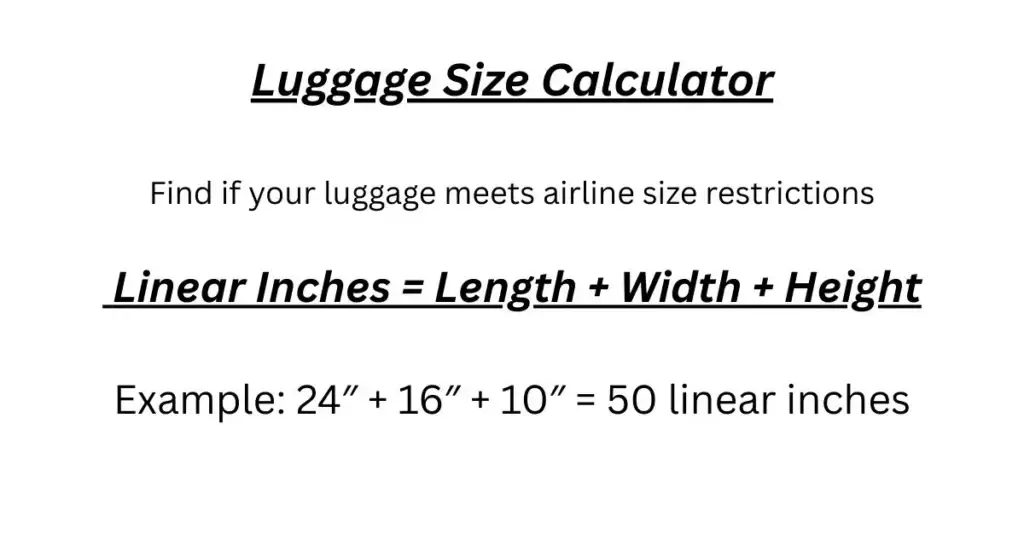
Here’s my straightforward definition: A luggage size calculator adds together your suitcase’s length, width, and height to check if it meets airline baggage restrictions before you ever reach the airport.
Think of it as your personal pre-flight luggage checker. You provide three simple measurements, and this handy tool instantly tells you where your bag stands: carry-on compliant, needs checking, or risks oversized fees. But here’s what most people miss—it’s not just about adding numbers. It’s about understanding how airlines actually evaluate your luggage at that check-in counter.
Now, let me clarify something important. This isn’t the same as a luggage volume calculator (which multiplies dimensions to find capacity) or a baggage weight calculator. Those tools serve different purposes. The luggage size calculator specifically addresses what airlines call “linear dimensions”—the total of length + width + height that determines whether your bag fits their physical frames and overhead bins.
Your Go-To Luggage Measurement Tool: How It Actually Works
So how does this luggage size calculator help you in real situations? Let me explain it in plain terms. You’ll enter three numbers: your suitcase’s length (the longest side), width (the side going across), and height (how tall it stands). The calculator then does the simple math airlines use: it adds them together.
But here’s where the real value comes in—the luggage size calculator doesn’t just give you a number. It interprets that total against standard airline policies. Most carriers follow these general categories: carry-on (usually under 115 cm total), checked baggage (115-158 cm), and oversized (over 158 cm). The calculator shows you exactly which category your luggage falls into, often with helpful color coding.
What I particularly appreciate is how the luggage size calculator handles those tricky exceptions. While standard dimensions work for most major airlines, some budget carriers have stricter limits. A good luggage size calculator will alert you to these variations, helping you avoid unpleasant surprises with airlines like Ryanair or Spirit.
Real Reasons Smart Travelers Use a Luggage Size Calculator
As someone who’s helped countless travelers, I’ve seen firsthand why people reach for a luggage size calculator. Let me share the most common situations where this tool becomes essential:
For students on a budget: When you’re packing everything from your dorm room into one suitcase, it’s tempting to overstuff. The luggage size calculator tells you in advance whether you’ll need to check that bag or if you can carry it on and save those precious dollars.
For avoiding baggage fees: Many budget airlines charge significant fees for checked bags—and even more for oversized items. Using a luggage size calculator helps you select luggage that definitely fits carry-on restrictions, potentially saving $50-100 each way.
For international travel confusion: Different countries use different measurement systems. European airlines typically use centimeters; U.S. airlines often list inches. The luggage size calculator handles these conversions seamlessly, preventing costly mistakes on multi-airline trips.
For online shopping confidence: Luggage dimensions in product descriptions can be misleading. That “carry-on compliant” suitcase might be slightly too large in reality. The luggage size calculator lets you verify those product dimensions against actual airline rules before you spend your money.
For packing strategy: Sometimes the difference between carry-on and checked comes down to how you pack. A soft-sided suitcase might have some compressibility. The luggage size calculator gives you a baseline measurement, helping you understand how much “squish room” you actually have.
The Simple Math Behind Airline Baggage Rules
Let me show you the exact formula every luggage size calculator uses:
Total Linear Dimensions = Length + Width + Height
Now, let me break down what each term really means in practice:
Length (L): This is the longest horizontal measurement when your suitcase lies flat. For most suitcases, this is the side with the handle. When airlines refer to “length,” they mean this specific dimension—not whatever looks longest to you.
Width (W): This is the measurement going across, perpendicular to the length. For standard rectangular luggage, it’s the other horizontal dimension. Important clarification: Some travelers confuse width with depth. On most suitcases, width and depth are the same unless you have an unusually shaped bag.
Height (H): This is how tall your suitcase stands when upright. Here’s the crucial part everyone misses: This includes fixed handles and wheels. Yes, wheels count! Airlines measure everything.
Why this specific formula matters: Airlines use the sum of three dimensions rather than volume because it’s practical to enforce at check-in. Those metal size-check frames at airports? They’re literally designed so that if your bag fits, the sum of its dimensions falls within limits. The formula represents the actual physical test your luggage must pass.
And why not volume? Volume (length × width × height) tells you how much your suitcase holds, but airlines don’t primarily care about capacity—they care about how much space your bag occupies in their overhead bins or cargo holds. Two bags with identical volume can have completely different shapes that fit differently in aircraft storage. The linear dimension formula ensures fairness regardless of your luggage shape.
Step-by-Step: How to Use Any Luggage Size Calculator Correctly
Let me walk you through the proper way to use a luggage size calculator, based on years of teaching this process:
Step 1: Measure Your Luggage Properly
Before you even open the luggage size calculator, you need accurate measurements. Place your empty suitcase on a flat surface. Use a flexible measuring tape (not a rigid ruler) and measure in either centimeters or inches—but be consistent. Include wheels, handles, and any permanent protrusions. Airlines certainly will. Measure at the widest points, following contours honestly.
Step 2: Enter Your Dimensions Carefully
In the luggage size calculator, you’ll see three clearly labeled fields. Enter your length, width, and height using the same measurement system. Most luggage size calculators default to centimeters since that’s what international airlines use predominantly, but you can typically switch to inches if that’s what your tape shows.
Step 3: Understand the Calculation Process
When you click “Calculate,” the luggage size calculator performs simple addition—but then does something more valuable. It compares your total to stored dimension limits from various airlines. It doesn’t just give you a number; it interprets that number based on real airline baggage policies.
Step 4: Interpret Your Results Wisely
The luggage size calculator categorizes your result visually. If your total is under 115 cm (45 inches), you’ll typically see a green “Carry-on Compliant” message. Between 115-140 cm (45-55 inches) often gets a yellow “May Need Checking” warning. Between 140-158 cm (55-62 inches) is usually “Checked Baggage.” Over 158 cm (62 inches) triggers a red “Oversized” alert with fee warnings.
Why each step matters: Measuring correctly ensures your luggage size calculator result matches what airlines will actually measure. Using consistent units prevents mathematical errors. The categorization saves you from memorizing every airline’s specific limits. The color coding provides instant visual feedback—you don’t need to interpret numbers, just look for green, yellow, or red indicators.
Practical Examples: The Luggage Size Calculator in Action
Let me show you exactly how the luggage size calculator works with real-world examples:
Example 1: Standard Student Carry-On
Maria is flying home from college for winter break. Her soft-sided suitcase measures 56 cm long, 38 cm wide, and 22 cm tall including wheels.
Length: 56 cm
Width: 38 cm
Height: 22 cm
Calculation: 56 + 38 + 22 = 116 cm
Luggage size calculator result: 116 cm total
The luggage size calculator shows “Borderline – May Need Checking” in yellow. At 116 cm, Maria’s suitcase is just 1 cm over the typical 115 cm carry-on limit. She now knows she has options: she could remove a few items to compress the bag slightly, or be prepared to check it if required.
Example 2: Family Vacation Checked Bag
The Johnson family has a large hard-shell suitcase measuring 74 cm × 47 cm × 32 cm.
Length: 74 cm
Width: 47 cm
Height: 32 cm
Calculation: 74 + 47 + 32 = 153 cm
Luggage size calculator result: 153 cm total
The luggage size calculator clearly shows “Checked Baggage Required” in blue. This tells the Johnsons they’ll definitely need to check this bag. The good news? It’s under the 158 cm oversize threshold, so they’ll pay standard checked baggage fees, not expensive oversized fees.
Example 3: Sports Equipment Challenge
David is traveling with ski equipment in a specialized bag measuring 95 cm × 38 cm × 42 cm.
Length: 95 cm
Width: 38 cm
Height: 42 cm
Calculation: 95 + 38 + 42 = 175 cm
Luggage size calculator result: 175 cm total
The luggage size calculator immediately shows “Oversized – Additional Fees Apply” in red with clear warnings. At 175 cm, David’s bag significantly exceeds the standard 158 cm limit. He now knows he needs to either call the airline about special sports equipment policies, consider shipping separately, or budget for oversized baggage fees that could reach $200 each way.
Luggage Size Calculator Results: What Different Measurements Mean
Let me help you understand how various luggage measurements translate into real travel situations:
| Length (cm) | Width (cm) | Height (cm) | Total (cm) | Luggage Size Calculator Result | Practical Meaning |
|---|---|---|---|---|---|
| 52 | 36 | 21 | 109 | Carry-on Compliant | Fits most airlines easily with room to spare |
| 57 | 41 | 24 | 122 | Checked Baggage Recommended | Too large for carry-on on most airlines |
| 62 | 43 | 28 | 133 | Checked Baggage Required | Definitely needs checking but standard size |
| 72 | 48 | 34 | 154 | Checked Baggage | Still within standard checked limits |
| 82 | 53 | 38 | 173 | Oversized Luggage | Will incur significant additional fees |
| 55 | 38 | 23 | 116 | Borderline Carry-on | May pass some airlines, fail others |
What these patterns teach us: Notice how small increases in each dimension accumulate quickly. A suitcase measuring 57×41×24 seems only slightly larger than 52×36×21, but that extra 5 cm here and 3 cm there adds up to 13 cm total difference—potentially pushing your bag from “carry-on” to “checked.” This is why precise measurement matters so much.
Also understand that airlines care about the total linear inches, not individual dimensions. A bag measuring 70×30×30 has the same total (130 cm) as one measuring 60×40×30, but they’re different shapes. Airlines use the total dimension because their size-check frames accommodate various shapes as long as the sum stays within limits.
Common Luggage Measurement Mistakes (And How to Avoid Them)
Through years of teaching, I’ve seen the same luggage measurement errors repeatedly. Here are the most common mistakes with the luggage size calculator and how to avoid them:
Mistake 1: Forgetting Wheels and Handles
This is the number one error. Airlines measure everything—wheels, telescoping handles (when collapsed), side handles, every protrusion. If your suitcase is 50 cm tall without wheels but 55 cm with wheels, you must use 55 cm in the luggage size calculator.
How to fix: Always measure at the absolute furthest points. Run your measuring tape over wheels and handles, not around them.
Mistake 2: Mixing Measurement Units
Entering length in centimeters, width in inches, and height in centimeters will give nonsense results. The luggage size calculator adds numbers mathematically but can’t detect unit errors.
How to fix: Pick one measurement system and stick with it. If your measuring tape shows both, mentally commit to one before starting.
Mistake 3: Measuring Empty When You’ll Pack Full
A soft-sided suitcase can expand significantly when packed. That 38 cm width might become 43 cm when stuffed with everything.
How to fix: Either measure while packed (for trips you repeat) or add 2-3 cm to each dimension as a buffer if you tend to overpack.
Mistake 4: Assuming Universal Airline Limits
While luggage size calculators use standard industry dimensions, some budget airlines have stricter policies. A bag that’s “carry-on compliant” at 115 cm might be too large for Ryanair’s 55×40×20 cm (115 cm total) policy because Ryanair also limits individual dimensions.
How to fix: Use the luggage size calculator as your first check, then verify with your specific airline if flying budget carriers.
Mistake 5: Overlooking Personal Items
Many travelers forget that besides carry-on luggage, you’re usually allowed a “personal item” like a backpack. If your carry-on is borderline, you might shift some items to your personal bag to reduce bulk.
How to fix: Use the luggage size calculator for both your main bag and personal item if it’s substantial.
Luggage Size Calculator Accuracy: What You Can Really Trust
Let me be perfectly honest about what the luggage size calculator can and cannot do for you:
Mathematical accuracy: The luggage size calculator is essentially 100% accurate at its core function—adding three numbers. This simple addition is reliable every time.
Policy accuracy: The calculator uses generally accepted industry standards (typically 115 cm for carry-on, 158 cm for checked baggage before oversize fees). These are accurate for most major airlines like Delta, American, United, British Airways, and Lufthansa.
Important limitations: The luggage size calculator cannot include every airline’s exact current policy, as these change frequently. It gives you a reliable baseline. Always double-check with your specific airline, especially for budget carriers or international routes.
Measurement dependency: The calculator’s usefulness depends entirely on your measurement accuracy. If you measure incorrectly, the result will be misleading even though the calculation is mathematically correct.
Shape considerations: Most luggage size calculators only consider total linear dimensions. Some airlines also restrict individual dimensions—requiring that no single measurement exceeds a certain length. Our standard luggage size calculator doesn’t check individual dimensions.
Real-world testing: I always recommend the “physical test” alongside the luggage size calculator. If your bag fits easily into a standard 22″ × 14″ × 9″ carry-on box (the common U.S. standard), it will almost certainly pass airline checks.
Your Luggage Size Questions Answered
How strict are airlines with luggage size limits?
Most are reasonably strict, especially when flights are full. Budget airlines tend to be more stringent as baggage fees are significant revenue sources. During peak travel times, enforcement often tightens.
What if my soft-sided bag compresses slightly?
Some compression is acceptable, but don’t count on more than 2-3 cm of “squish.” If your bag relies on compression to meet limits, you’re taking a risk.
Do expandable suitcases count as expanded or unexpanded?
Measure with the expansion zipper closed/unexpanded. If you plan to use the expanded space, measure it expanded and use those dimensions in your luggage size calculator.
How do I measure duffel bags or irregular shapes?
For non-rectangular bags, measure the longest point in each dimension. For a cylindrical duffel, measure diameter (for both length and width) and height. The luggage size calculator still adds these three measurements.
Are there different rules for international versus domestic flights?
Usually dimension limits are consistent, but weight allowances often differ. Always check your specific airline’s international baggage policy page.
What about musical instruments or medical equipment?
Most airlines have special policies for these items. Use the luggage size calculator to get baseline measurements, then contact your airline about special accommodations.
How often should I check airline luggage policies?
Airlines can change policies at any time. Check within two weeks of booking and again a week before travel, especially if flying budget carriers.
What’s the actual cost of oversized baggage?
Fees vary by airline but typically range from $100-300 each way for significantly oversized luggage. Some airlines charge by both size and weight.
Do airlines measure at the gate or only at check-in?
Both. Gate agents often perform random checks, especially on busy flights with full overhead bins.
Can I challenge a luggage size measurement?
You can politely ask for a remeasurement, but ultimately airline staff have final authority. This is why using a luggage size calculator beforehand is so valuable.
Start Using Your Luggage Size Calculator Today
Now that you understand how luggage sizing works and why precision matters, I encourage you to try our luggage size calculator with your own bags. Measure carefully, enter accurate numbers, and see where your luggage truly stands. This simple check could save you time, stress, and significant money on your next trip.
Remember what I tell my students: Knowledge about luggage dimensions is power. Power to avoid fees, power to pack smarter, power to travel with confidence. Whether you’re a student heading home, a family planning vacation, or a frequent business traveler, mastering your luggage size calculator usage makes every journey smoother.
Related Travel Tools You Might Find Helpful
Travel Packing Calculator: Once you know your luggage size, this tool helps maximize what fits inside. It suggests optimal packing arrangements and helps prevent overpacking.
Trip Budget Calculator: Travel costs involve more than baggage fees. This calculator helps estimate total trip expenses including flights, accommodations, meals, and activities.
International Travel Checklist: For those crossing borders, this comprehensive checklist ensures you don’t forget important documents, adapters, or health considerations.
The right tools and knowledge transform travel from stressful to seamless. Your luggage size calculator is the first step toward smarter, more economical journeys. Safe travels and happy packing!