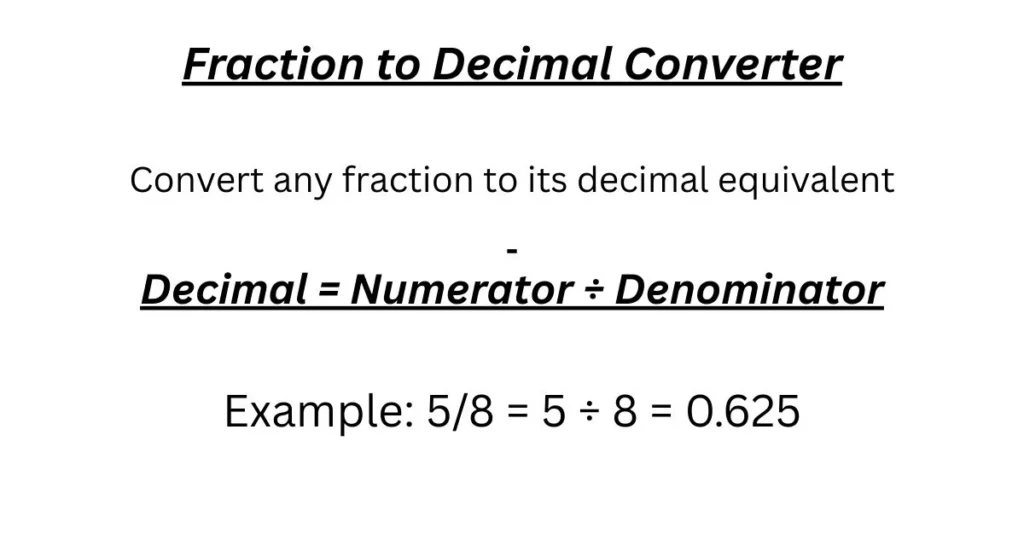
Fraction to Decimal Converter
How it works: To convert a fraction to a decimal, divide the numerator (top number) by the denominator (bottom number). For example, 3/4 = 3 ÷ 4 = 0.75. If you enter a negative number in either field, the result will be negative. Division by zero is not allowed.
How to Easily Turn Fractions Into Decimals
Let me ask you something. Have you ever been cooking from an old family recipe that calls for ¾ of a cup, but your measuring cup only has lines for decimals like 0.25, 0.5, and 0.75? Or maybe you’re building something from plans that say to cut a board at ⅝ of an inch, but your tape measure has those tiny decimal markings too? This gap between fractions and decimals trips up so many people every single day.
I remember sitting with my nephew last year trying to help with his math homework. He stared at the fraction ⅜ like it was written in another language. “I just don’t get how this becomes a decimal number,” he said. That moment made me realize how many people struggle with this simple but essential skill.
What Exactly is a Fraction to Decimal Converter?
Let me explain this in the simplest way possible. A fraction to decimal converter is a tool—it could be an online calculator, an app on your phone, or even just the method in your head—that changes fractions into decimals. When you look at a fraction like ½, it’s really just another way of writing 0.5. The converter does that translation for you.
Think about it like this: fractions and decimals are two different languages for talking about the same numbers. The fraction ¾ and the decimal 0.75 are saying exactly the same thing—they’re just using different words. A good converter is like having a friend who’s fluent in both languages and can translate instantly.
The Simple Secret Behind Every Conversion
Here’s the part that surprises most people: the formula for converting any fraction to a decimal couldn’t be simpler. Ready?
Divide the top number by the bottom number.
That’s it. That’s the whole secret.
When you see a fraction written as 3/4, that line in the middle isn’t just a line—it’s actually a division symbol. So 3/4 really means “3 divided by 4.” When you do that calculation (3 ÷ 4), you get 0.75.
Let me show you why this makes perfect sense with a real example. Say you order a pizza and it comes cut into 8 slices. You eat 3 of them. What portion of the whole pizza did you eat? You had 3 slices out of 8 total slices, which is the fraction ⅜. To figure out what decimal that is (what percentage of the whole pizza), you just divide: 3 ÷ 8 = 0.375. You ate 0.375 (or 37.5%) of the pizza.
Let Me Walk You Through Some Real Examples
Example 1: Converting ½ to a decimal
The fraction: ½
What it means: 1 ÷ 2
The math: How many times does 2 go into 1? It doesn’t, so we write 0. But 2 goes into 10 five times exactly.
The answer: 0.5
Real life use: That half-dollar coin? It’s worth $0.50.
Example 2: Converting ⅓ (this one’s interesting)
The fraction: ⅓
What it means: 1 ÷ 3
The math: 3 goes into 1.000… forever. It becomes 0.3333…
The answer: 0.333… (we usually write this as 0.3 with a line over the 3)
Why it matters: Some decimals never end neatly, and that’s okay! A good converter shows you the repeating pattern.
Example 3: Converting 2 ¼ (a mixed number)
The number: 2 ¼
Step 1: Handle the whole number first—that 2 just stays as 2
Step 2: Convert the fraction part: ¼ = 1 ÷ 4 = 0.25
Step 3: Put them together: 2 + 0.25 = 2.25
Tip: Many converters let you enter mixed numbers directly
When Will You Actually Use This in Real Life?
You might be thinking, “Okay, but when will I actually need this?” Let me tell you—more often than you’d guess:
1. In the kitchen
That recipe card from your grandma that calls for ⅔ cup of sugar? Your modern liquid measuring cup probably shows milliliters or has decimal markings. Knowing that ⅔ equals about 0.667 helps you measure accurately.
2. During home projects
Ever tried to build furniture from plans that use fractions? Most power tools and digital measuring tapes use decimals. When the instructions say “drill at 5/16 inch,” but your drill’s depth gauge shows decimals, you need to know that 5/16 = 0.3125.
3. When you’re shopping
Is ⅓ off better than 30% off? If you convert ⅓ to approximately 0.333 (or 33.3%), you can see that 33% off is actually slightly better than 30% off.
4. Reading weather reports
When the meteorologist says there’s a 1/8 inch of rain expected, that’s 0.125 inches. It helps you understand just how much (or how little) rain that really is.
5. Following sports statistics
If a basketball player makes 7 out of 10 free throws, that’s 7/10 or 0.7, which is a 70% free throw percentage. Much easier to compare players when everything’s in decimals!
Why Fractions and Decimals Matter
Let me start with a confession: I spent most of sixth grade convinced fractions and decimals were two completely different worlds. I’d look at 3/4 on a recipe, then see 0.75 on my calculator, and think they were somehow separate creatures. Then my math teacher, Mrs. Jenkins, drew a simple picture on the board—a circle split into four pieces with three shaded. “This,” she said, pointing to the shaded part, “is 3/4. And when we write it as 0.75, we’re just saying the same thing in a different language.”
That moment changed everything for me. Now, as someone who’s taught math for fifteen years, I see students have that same “aha!” moment every semester when they realize fractions and decimals aren’t enemies—they’re just different ways of expressing the same mathematical truth.
This guide will help you become fluent in translating between these two mathematical languages. Whether you’re staring at a homework problem that says “convert to decimal form” or trying to figure out if 5/8 is more or less than 0.6 on a ruler, you’ll find everything you need right here.
What Exactly Is a Fraction to Decimal Converter?
In the simplest terms possible: A Fraction to Decimal Converter is a tool that divides the top number of a fraction by the bottom number and gives you the answer in decimal form.
That’s it. No magic, no complicated formulas—just clean, straightforward division. But here’s what makes it special: it handles all the tricky parts for you. Mixed numbers like 2 ½? It knows what to do. Repeating decimals like 0.333…? It shows the pattern clearly. Unusual fractions like 22/7? It calculates precisely.
Think of it like this: if fractions and decimals are two different languages, the converter is your personal translator who’s perfectly fluent in both. You give it “three-quarters” in Fraction, and it instantly tells you “zero point seven five” in Decimal.
Why You’ll Actually Use This (Beyond Homework)
Let’s be honest—when you first learn about converting fractions to decimals, it feels like just another math class exercise. But this skill pops up everywhere in real life:
In the kitchen: Your recipe calls for 3/4 cup of flour, but your digital scale measures in decimals. Is that 0.75 or 0.8? Knowing how to convert means your cookies come out perfect.
In the workshop: Your project plans say to drill a hole at 5/16 of an inch from the edge. Your digital caliper shows decimals. Where exactly should you mark?
When shopping: Which discount is better—1/3 off or 30% off? Convert 1/3 to approximately 0.333 (or 33.3%) and the answer is clear.
In sports: Your favorite basketball player makes 7 out of 10 free throws. That’s 7/10, which converts to 0.7 or 70%. Now you can compare her to players with different attempt numbers.
The truth is, decimals are the language of measurement tools, digital devices, and precise calculations. Fractions are the language of ratios, recipes, and traditional measurements. Being bilingual in this mathematical sense makes life easier.
The Heart of the Matter: The Fraction to Decimal Formula
Here’s where we get to the beautiful simplicity of it all. Every single fraction to decimal conversion uses exactly the same formula:
Decimal = Numerator ÷ Denominator
Or, in plain English: Decimal = Top Number ÷ Bottom Number
Let me explain why this works with something we all understand: pizza.
Imagine a pizza cut into 4 equal slices (that’s your denominator—the total number of pieces). You have 3 slices on your plate (that’s your numerator—the pieces you actually have). To figure out what fraction of the whole pizza you have, you ask: “My 3 slices out of the total 4 slices equals what portion?”
The answer comes from division: 3 ÷ 4 = 0.75. You have 0.75 (or 75%) of the pizza.
The fraction bar in 3/4 isn’t just a line—it’s actually a division symbol in disguise. So 3/4 literally means “3 divided by 4.”
Understanding the Key Players: Numerator and Denominator
Before we go further, let’s make sure we’re clear on terms:
Numerator (Top Number): This tells you how many parts you have. In our pizza example, it’s how many slices are on your plate. In the fraction 5/8, the numerator is 5—you have 5 of something.
Denominator (Bottom Number): This tells you how many parts make a whole. For the pizza, it’s how many slices the entire pizza was cut into. In 5/8, the denominator is 8—it takes 8 of these parts to make one complete unit.
The Golden Rule: The denominator can NEVER be zero. Why? Because you can’t divide something into zero parts. If a recipe said “cut the pizza into 0 slices,” you’d just stare at it confused. Math feels the same way about dividing by zero—it simply doesn’t make sense.
Step-by-Step: How to Convert Fractions to Decimals
Method 1: The Calculator Method (Quick and Reliable)
This is what our Fraction to Decimal Converter does automatically:
Enter the numerator (top number)
Enter the denominator (bottom number)
Press divide (or the “calculate” button)
Read your decimal answer
Example: For 3/8, you’d enter 3 ÷ 8 = 0.375
Method 2: Long Division (The “Show Your Work” Method)
Sometimes you need to do it by hand. Here’s how:
0.375
_______
8 ) 3.000
-2.4
—–
60
-56
—–
40
-40
—–
0
Set up 3 ÷ 8 (with 3 as 3.000 inside the division bracket)
8 doesn’t go into 3, so write 0. above the 3, then a decimal point
Add a zero to make 30. 8 goes into 30 three times (8×3=24)
Subtract 24 from 30 to get 6, bring down a zero to make 60
8 goes into 60 seven times (8×7=56), subtract to get 4
Bring down a zero to make 40, 8 goes into 40 five times exactly
Your answer is 0.375
Method 3: Converting to an Equivalent Fraction
For some fractions, you can find an equivalent fraction with a denominator of 10, 100, or 1000:
Example: Convert 1/4 to a decimal
Multiply numerator and denominator by 25: (1×25)/(4×25) = 25/100
25/100 = 0.25 (twenty-five hundredths)
This works beautifully for fractions whose denominators are factors of 10, like 2, 4, 5, 20, 25, 50.
Types of Decimals You’ll Encounter
When you convert fractions, you get two main types of decimals:
Terminating Decimals: These come to a clean end.
1/2 = 0.5
3/4 = 0.75
7/8 = 0.875
Repeating Decimals: These have a digit or group of digits that repeat forever.
1/3 = 0.333… (usually written as 0.3 with a bar over the 3)
2/3 = 0.666… (0.6 with a bar over the 6)
5/6 = 0.8333… (0.83 with a bar over just the 3)
How to know which you’ll get: Look at the denominator in its simplest form. If its only prime factors are 2 and/or 5, you’ll get a terminating decimal. If it has any other prime factor (like 3, 7, 11), you’ll get a repeating decimal.
Worked Examples: From Simple to Complex
Example 1: Simple Proper Fraction
Convert 3/5 to a decimal
Using the formula: Decimal = 3 ÷ 5 = 0.6
Why this works: 3/5 means “3 divided by 5.” Since 5 is a factor of 10, we could also convert to tenths: 3/5 = 6/10 = 0.6
Real-world meaning: If you have 3 out of 5 problems correct on a quiz, you have 60% (0.6) correct.
Example 2: Improper Fraction
Convert 7/4 to a decimal
Using the formula: Decimal = 7 ÷ 4 = 1.75
Why this works: 7/4 means “7 divided by 4.” Since 4 goes into 7 one whole time with 3 left over, we know our answer will be more than 1.
Real-world meaning: If you need 7/4 cups of flour, that’s 1 full cup plus 3/4 of another cup, or 1.75 cups.
Example 3: Mixed Number
Convert 2 3/8 to a decimal
Step 1: Handle the whole number part: 2 stays as 2.
Step 2: Convert the fraction part: 3 ÷ 8 = 0.375
Step 3: Combine: 2 + 0.375 = 2.375
Why this works: A mixed number is just a whole number plus a fraction. Convert each part separately.
Real-world meaning: A board that’s 2 3/8 inches long is exactly 2.375 inches.
Example 4: Repeating Decimal
Convert 5/6 to a decimal
Using the formula: 5 ÷ 6 = 0.833333…
Proper notation: Write this as 0.83 with a bar over the 3
Why it repeats: When you divide 5 by 6, you get a remainder of 2, then 20 ÷ 6 = 3 with remainder 2, then 20 ÷ 6 = 3 with remainder 2… the pattern continues forever.
Real-world approximation: For most practical uses, you’d round to 0.833 or even 0.83.
Example 5: Fraction with Large Numbers
Convert 17/25 to a decimal
Method 1 (division): 17 ÷ 25 = 0.68
Method 2 (equivalent fractions): Multiply numerator and denominator by 4: (17×4)/(25×4) = 68/100 = 0.68
Why both work: Since 25 is a factor of 100, the equivalent fraction method is efficient. But division always works.
Real-world meaning: If 17 out of 25 students passed a test, that’s 68% (0.68) passing.
Common Patterns and Shortcuts
After converting enough fractions, you’ll start to recognize patterns:
Halves: 1/2 = 0.5, 3/2 = 1.5, 5/2 = 2.5 (always end in .5)
Fourths: 1/4 = 0.25, 2/4 = 0.5, 3/4 = 0.75 (memorize these three!)
Eighths: 1/8 = 0.125, 3/8 = 0.375, 5/8 = 0.625, 7/8 = 0.875 (notice they all end in 125, 375, 625, or 875)
Fifths: 1/5 = 0.2, 2/5 = 0.4, 3/5 = 0.6, 4/5 = 0.8 (nice easy decimals)
Tenths: These are the easiest! 1/10 = 0.1, 3/10 = 0.3, 7/10 = 0.7 (just move the decimal one place left)
Input-Output Table: Seeing the Patterns
| Fraction Input | Decimal Output | Type | Notes |
|---|---|---|---|
| 1/2 | 0.5 | Terminating | Easy to remember |
| 1/3 | 0.333… | Repeating | One-digit repeat pattern |
| 1/4 | 0.25 | Terminating | Quarter, like 25 cents |
| 1/5 | 0.2 | Terminating | Simple one-decimal place |
| 1/6 | 0.1666… | Repeating | Repeats “6” after initial “1” |
| 1/8 | 0.125 | Terminating | Common in measurements |
| 1/10 | 0.1 | Terminating | Decimal system base |
| 2/3 | 0.666… | Repeating | Two-thirds, common fraction |
| 3/4 | 0.75 | Terminating | Three-quarters, very common |
| 5/8 | 0.625 | Terminating | Common in woodworking |
| 7/8 | 0.875 | Terminating | Almost a whole |
| 9/10 | 0.9 | Terminating | Almost a whole |
Common Mistakes and How to Avoid Them
Mistake #1: Dividing backwards
Wrong: 4 ÷ 3 for 3/4
Right: 3 ÷ 4 for 3/4
Memory trick: Numerator UP, Denominator DOWN (divide UP by DOWN)
Mistake #2: Misplacing the decimal
When doing long division, remember to place the decimal point in your answer directly above its position in the number you’re dividing.
Mistake #3: Not recognizing when you’re done
In long division, you’re done when you get a remainder of 0 (terminating decimal) or when you see a repeating pattern (repeating decimal).
Mistake #4: Forgetting about mixed numbers
When you see something like 2 1/3, convert the mixed number to an improper fraction (7/3) first, or handle the whole number and fraction separately.
Mistake #5: Rounding too early
When working with repeating decimals, carry out the division until you see the pattern clearly before rounding.
Frequently Asked Questions
Q: Why can’t I just use my calculator for everything?
A: You absolutely can! But understanding how it works helps you catch errors. If you enter 3/4 and get 1.333…, you’ll know that’s wrong because you understand 3 divided by 4 should give you less than 1.
Q: What if I get a really long decimal?
A: For most practical purposes, you can round. The general rule is to round to one more decimal place than your measurement tool can read. If your ruler measures to 1/16 inch (about 0.06), round your decimal to the hundredths place (0.xx).
Q: How do I convert a decimal back to a fraction?
A: Write it as a fraction with a denominator of 1 followed by zeros (0.75 = 75/100), then simplify (75/100 = 3/4).
Q: Are fractions or decimals more accurate?
A: For exact values, fractions are often more precise. 1/3 is exact; 0.333 is an approximation. But for calculations, decimals are usually easier to work with.
Q: Why do we need both systems anyway?
A: Fractions are intuitive for parts of a whole (half a sandwich). Decimals are efficient for calculations and align with our base-10 number system. Each has its strengths.
Try It Yourself: Practice Problems
Convert 4/5 to a decimal
Convert 5/12 to a decimal (round to three places)
Convert 1 7/8 to a decimal
Which is larger: 5/9 or 0.55?
If you have 7/16 of a pizza, what decimal represents your portion?
(Answers: 1) 0.8, 2) 0.417, 3) 1.875, 4) 5/9 ≈ 0.556 so 5/9 is larger, 5) 0.4375)
Related Tools for Further Learning
Once you’ve mastered fraction to decimal conversion, you might want to explore related mathematical tools:
Percentage Calculator: Since percentages are just decimals multiplied by 100, this is the natural next step.
Ratio Calculator: Ratios are closely related to fractions and often need conversion for comparison.
Measurement Converter: Many measurement conversions involve fractions that need to be converted to decimals for calculation.
Probability Calculator: Probabilities are often expressed as fractions that convert to decimal percentages.
Conclusion: You’ve Got This!
Converting fractions to decimals might seem intimidating at first, but remember—it’s just division. Every single time. The formula never changes: Decimal = Numerator ÷ Denominator.
Whether you’re using our Fraction to Decimal Converter for a quick answer or working through long division to understand the process, you’re developing a valuable skill that connects the intuitive world of fractions with the precise world of decimals.
The next time you see a fraction, don’t panic. Just remember: top number divided by bottom number. That’s your decimal. And with practice, you’ll start to recognize common conversions instantly—knowing that 5/8 is 0.625 or that 2/3 is approximately 0.667.
Math is a language, and like any language, fluency comes with practice. You’re learning to speak both “Fraction” and “Decimal,” and that’s a skill that will serve you well in math class and beyond.
Happy converting!
