Complex Fraction Calculator
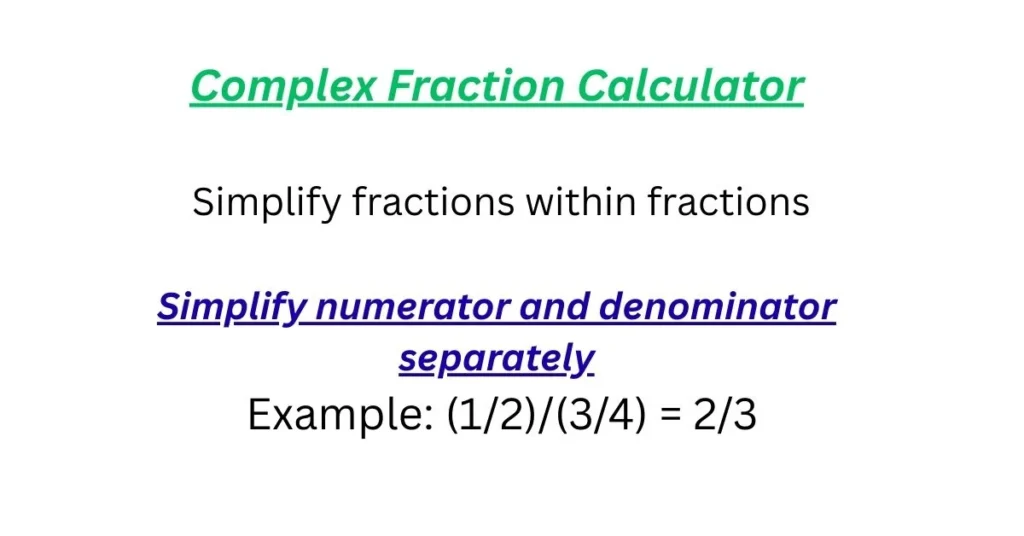
Simplify fractions within fractions with our step-by-step calculator. Perfect for homework help and test preparation.
Worked Examples
Problem: (3/4) ÷ (2/5)
Click Calculate to see step-by-step solution
Change first fraction to: 2 (enter as 2/1) ÷ (3/4)
Shows how to handle whole numbers in complex fractions
Try: (6/8) ÷ (9/12)
Watch how it simplifies to 1
Input-Output Patterns
| First Fraction | Second Fraction | Result | Pattern |
|---|---|---|---|
| 1/2 ÷ 1/4 | 1/2 ÷ 1/4 | 2 | Dividing by smaller fraction = larger result |
| 2/3 ÷ 3/4 | 2/3 ÷ 3/4 | 8/9 ≈ 0.889 | Dividing by larger fraction = result < 1 |
| 5/6 ÷ 5/6 | 5/6 ÷ 5/6 | 1 | Same fractions = result of 1 |
| 7/8 ÷ 1/2 | 7/8 ÷ 1/2 | 7/4 = 1.75 | Dividing by 1/2 = multiplying by 2 |
Frequently Asked Questions
The Calculator That Changed My Math Class
How to Use a Complex Fraction Calculator for Better Math Understanding
Every September, I write the same problem on my whiteboard: (3/4) ÷ (1/2). I watch twenty-eight faces. Some look confident. Most look confused. Two look like they’d rather be anywhere else. I’ve taught middle school math for seventeen years, and this moment never changes. But this year, something different happened. Sarah raised her hand and asked, “Can we use that fraction division calculator again? The one that shows the step-by-step fraction simplification?”
What This Math Teaching Tool Actually Is
Understanding Complex Fraction Calculators
Let me tell you what this educational math calculator isn’t. It’s not an answer machine. It’s not a homework cheat. It’s not something you use during standardized testing.
What it truly is: a visual fraction problem solver that reveals mathematical thinking. A slowed-down version of what happens in a skilled mathematician’s brain. A patient fraction teaching aid that doesn’t get tired of repeating the process.
I compare it to watching a master craftsman at work. You could read about how to build a cabinet, but watching someone measure, cut, and assemble—that’s different. That’s real learning. This complex fraction division tool works the same way for mathematics.
How We Actually Implement This in Classroom Learning
Effective Calculator Integration Strategies
In Room 214, we developed our calculator rules together:
-
Brain-first approach: Try solving with just your mind and paper
-
Verification phase: Use the fraction calculation tool to check your work
-
Process analysis: Study how it arrives at the solution
-
Error identification: Find exactly where your thinking diverged
-
Independent re-attempt: Try again without technological assistance
Yesterday, I watched Carlos—who typically rushes through assignments—meticulously follow all five steps. He worked on (5/6) ÷ (2/3), wrote 15/12, simplified to 5/4, converted to 1.25. Then he engaged the fraction simplification calculator.
It displayed the same steps but added something crucial: the mixed number 1 1/4.
“Oh,” he murmured, making the connection. “I forgot that representation.” He corrected his paper immediately.
That moment of self-correction? That’s authentic learning. That’s why after seventeen years, I still love walking into my classroom each morning.
The Mathematical Thinking We’re Really Cultivating
Building Fraction Sense Through Visualization
I never begin with abstract formulas. I start with tangible concepts students already understand.
“Consider this,” I say. “Your grandmother’s cookie recipe requires 3/4 cup of sugar. Your measuring cup only has 1/3 cup markings. How many of those do you need?”
They ponder. They estimate. Some sketch little measuring cups. Others give me that familiar “I-have-no-idea” look.
Then we work through it collaboratively: (3/4) ÷ (1/3)
The step-by-step fraction calculator reveals: (3/4) × (3/1) = 9/4 = 2 1/4
“So,” I explain, “you’d need two full 1/3 cups, plus one filled just a quarter of the way.”
Heads nod. Comprehension dawns. The numbers transform from abstract symbols to meaningful quantities.
Common Fraction Challenges and Calculator Solutions
Identifying and Overcoming Mathematical Hurdles
After teaching this unit seventeen consecutive years, I recognize the consistent stumbling blocks:
Challenge One: The Reciprocal Rule
“Why do we invert the second fraction?” Every student asks. The fraction reciprocal calculator demonstrates this isn’t arbitrary—it’s mathematical consistency in action.
Challenge Two: Whole Number Recognition
Problems like 5 ÷ (1/3) paralyze students. They don’t perceive 5 as 5/1. The fraction conversion tool makes this relationship visible and concrete.
Challenge Three: Completion Recognition
Students frequently present 8/4 as a final answer. The fraction simplification calculator models the crucial final step: 8/4 = 2.
Challenge Four: Multiple Representations
When they calculate 7/5, they need to recognize that’s 1 2/5. The mixed number calculator feature displays both forms, building flexibility in mathematical thinking.
Real Classroom Moments with Fraction Tools
Documenting Mathematical Growth
Three incidents from this week deserve recording:
The Breakthrough Moment
Maria has struggled with fractions since October. Yesterday, she used the homework checking calculator to verify her work. Problem four was incorrect. Instead of simply copying the right answer, she employed the step-by-step solution display to pinpoint her exact error: multiplying 3×5 as 16 instead of 15. She corrected it herself. The pride was palpable and earned.
Collaborative Problem-Solving
During group work, one table designated the calculator their “mathematical referee.” Each member solved independently, then consulted the group math verification tool. When disagreements arose, they examined the calculation steps display together to determine correctness and understand why. They became inadvertent peer tutors.
Confidence Building
James, who prefaces every math session with “I’m terrible at fractions,” correctly solved six problems using the guided fraction calculator. He then attempted three additional problems independently—and succeeded. “Maybe I’m not completely hopeless at this,” he remarked. I recorded that exact phrase in my teaching journal.
Understanding Tool Limitations
Realistic Expectations for Educational Technology
I maintain complete transparency with students about technological limitations. This mathematics learning tool cannot:
-
Interpret word problems and establish equations
-
Determine when answers lack real-world sense
-
Assist during no-calculator assessments
-
Substitute for deliberate practice and repetition
What it does provide is mechanical step revelation. How students engage with those steps—that’s where genuine learning occurs.
Effective Implementation Strategies for Mathematical Tools
Practical Approaches That Actually Work
Based on observing hundreds of students, these methods prove effective:
For Beginners: Use as a pattern recognition tool. Input straightforward problems first. Observe consistent elements. Notice what remains constant. Then attempt similar problems independently.
For Homework Sessions: Complete all work first. Then employ as a verification calculator. Upon finding errors, don’t merely transcribe correct answers. Identify precise missteps. Rectify thinking processes, not just written responses.
For Study Practice: Create original problems—simple, complex, unconventional. Verify with the practice problem checker. Diverse problem exposure deepens understanding.
For Tutoring Sessions: Collaborate with the tool. Allow learners to input numbers. Verbalize each step as it appears. Pose questions: “What should happen next?”
Parent Questions About Educational Calculators
Addressing Common Concerns
During parent-teacher conferences, these inquiries surface consistently:
“Does This Constitute Cheating?”
No. Work verification isn’t cheating—it’s academic responsibility. Answer copying without comprehension is cheating. This tool fosters understanding.
“Will It Create Dependency?”
My experience suggests the opposite. As mathematical confidence grows, usage decreases. It functions like bicycle training wheels—temporary support until independent balance develops.
“Why Not Standard Calculators?”
Standard calculators yield decimals. This fraction-focused tool maintains fractional representations, which is essential for conceptual understanding.
“What’s Appropriate Usage Frequency?”
My guideline: attempt first, verify second. If verification dominates attempts, usage requires adjustment.
A Transformation Story
Witnessing Mathematical Growth
I want to share Lisa’s journey. She joined my class mid-year from another district. Her previous school’s reports showed consecutive failed math assessments. Fractions, she confessed, “just don’t click” for her.
We began lunchtime sessions. Initially, she merely observed calculator use. Gradually, she operated it herself. Eventually, she predicted outcomes.
“I believe it will invert this fraction,” she’d venture. Consistently correct.
By spring, she assisted classmates during collaborative work. “Observe,” she’d demonstrate. “Note what occurs with these inputs.”
Her final exam performance: 94% on fractions. Her father’s email arrived after semester grades: “She mentioned possibly selecting advanced mathematics next year. We’ve never heard that before.”
That academic transformation—that’s my teaching purpose. That’s why thoughtful educational tools matter profoundly.
Practical Problem Applications
Classroom-Tested Fraction Exercises
Try these actual problems from recent assignments:
Problem 1: Foundation Building
(2/5) ÷ (3/7)
Students typically multiply 2×7 and 5×3, obtaining 14/15. The decimal conversion calculator then shows approximately 0.933.
Problem 2: Whole Number Integration
6 ÷ (2/3)
Many learners miss that 6 equals 6/1. The fraction representation tool demonstrates: 6/1 × 3/2 = 18/2 = 9.
Problem 3: Conceptual Understanding
(1/3) ÷ (2/3)
This confuses students expecting larger results from division. The mathematical process calculator reveals: 1/3 × 3/2 = 3/6 = 1/2, illustrating that dividing by larger fractions yields smaller results.
The Core Learning Principle
Calculator as Conceptual Bridge
This educational technology tool doesn’t perform learning for students. It doesn’t execute thinking for them. It renders processes visible. It transfers internal mental operations to external displays for examination, study, and comprehension.
Once students internalize processes, visual displays become unnecessary. They execute mentally. They solve on paper. They explain to peers.
When explanation becomes possible—that signifies true understanding.