| Rent vs. Buy Calculator |
Rent vs. Buy Calculator
Make an informed decision about whether renting or buying a home makes more financial sense for your situation. Compare costs over time and see detailed breakdowns.
Input Parameters
Results
Total Cost of Renting
Total amount spent on rent over the selected time period, including rent increases.
Total Cost of Buying
Total amount spent on mortgage, taxes, insurance, and maintenance, minus home equity.
Recommendation
Enter your details and click Calculate to see whether renting or buying makes more financial sense for your situation.
| Factor | Renting | Buying |
|---|
Rent or Buy? A Real Talk Guide to Help You Decide (No Boring Math, I Promise!)
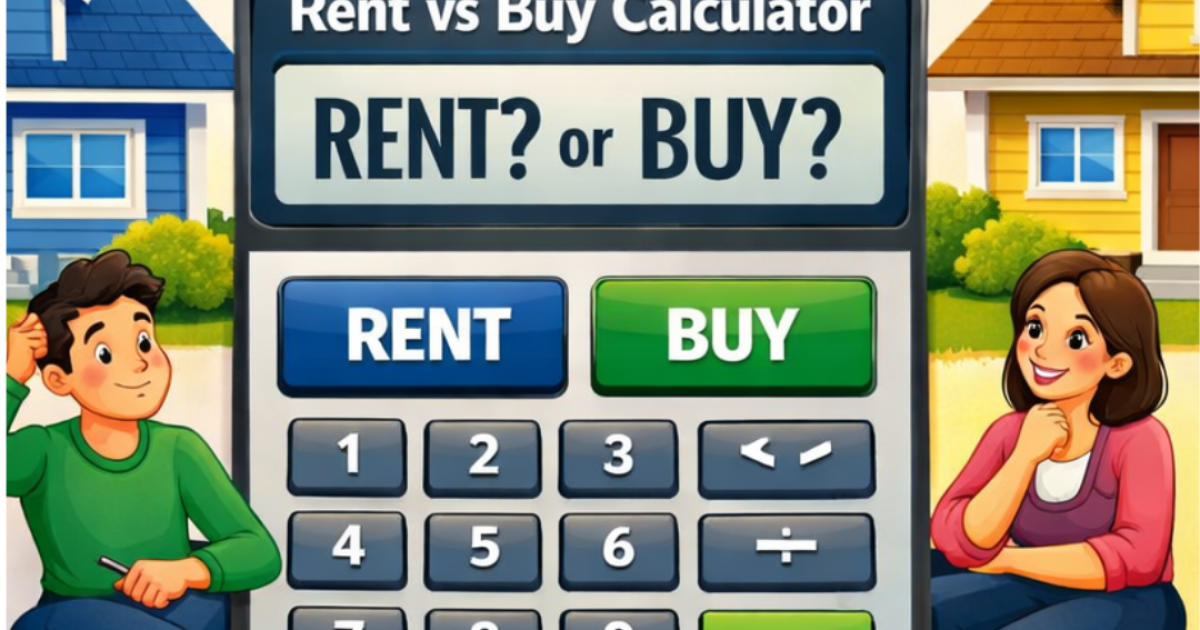
Hey there, future homeowner (or happy renter)! 👋
If you’re reading this, you’re probably staring at your laptop at 2 AM, crunching numbers, and wondering: “Should I keep renting or finally buy a place?”
I get it. I’ve been there too.
A few years ago, I was sitting in my tiny apartment, listening to my upstairs neighbor’s questionable karaoke skills, and wondering if I’d ever own a home. Then, when I finally saved up enough, I had to ask: “Is buying really better? Or am I just falling for the ‘American Dream’ hype?”
That’s why I’m writing this—not as some finance robot spitting out mortgage rates, but as someone who’s been in your shoes. Let’s figure this out together.
Renting vs. Buying: It’s Not Just About Money
Sure, a rent vs. buy calculator can give you cold, hard numbers. But let’s be real—this decision is emotional too.
The Renter’s Life
✅ Freedom: Feel like moving to a new city next year? No problem.
✅ No surprise costs: Leaky roof? Broken AC? Not your problem.
✅ Less stress: No property taxes, no lawn mowing, no “OMG, the water heater exploded.”
But…
❌ Rent hikes: That “great deal” apartment? It’ll cost $300 more next year.
❌ Zero equity: You’re basically paying your landlord’s mortgage.
The Homeowner’s Reality
✅ Stability: No more landlords raising rent because “the market changed.”
✅ Pride of ownership: Paint the walls neon pink if you want!
✅ Long-term wealth: Every payment builds equity (aka future you says thanks).
But…
❌ Upfront costs: Down payment + closing costs = 💸💸💸
❌ Maintenance: That “charming fixer-upper” might mean weekends at Home Depot.
“But My Friend Said Buying Is Always Better!” (Not So Fast…)
Ever heard someone say “Renting is throwing money away!”?
Yeah, me too. But here’s the truth:
-
If you move every few years, buying (and selling) can cost more than renting.
-
If home prices are insane (looking at you, San Francisco), renting might be smarter.
-
If you hate DIY disasters, not dealing with repairs is priceless.
A rent vs. buy calculator helps, but your life matters more than math.
When Renting Wins (Even If Your Parents Disagree)
1. You Love Flexibility
-
Job hopping?
-
Not sure where you want to settle?
-
Just really hate commitment?
Renting = No strings attached.
2. Your Down Payment Is a Mythical Creature
If saving 20% feels like climbing Everest in flip-flops, renting buys you time.
3. You’d Rather Travel Than Fix a Toilet
Some people love home projects. Others (like me) consider “IKEA assembly” a extreme sport.
When Buying Actually Makes Sense
1. You’re Planting Roots
Found your dream city? Great schools? A coffee shop that knows your order? Buying locks in stability.
2. You Can Handle the Real Costs
Mortgage + taxes + insurance + “Oh crap, the furnace died” = More than just the listing price.
3. You Want to Build Wealth (Slowly)
Unlike rent, mortgage payments actually go toward your net worth.
The Real-Life Test: What I Did (And What I’d Do Differently)
My Story:
-
Rented through my 20s (zero regrets—I moved cities twice).
-
Bought at 30 (loved the stability but underestimated repair costs).
-
Almost panicked when the AC died in the middle of summer.
What I Learned:
-
Renting gave me freedom when I needed it.
-
Buying forced me to save (but also taught me about home warranties).
“Just Tell Me What to Do!” (Fine, Here’s the Cheat Sheet)
Rent if…
-
You move a lot.
-
You can’t afford 20% down + emergency savings.
-
The thought of home repairs makes you sweat.
Buy if…
-
You’ll stay 5+ years.
-
You have steady income + savings.
-
You’re ready for the responsibility (and the pride).
Still stuck? Try this:
-
Use a rent vs. buy calculator (I like NerdWallet’s).
-
Talk to a real human financial advisor (not just Zillow).
Rent vs. Buy FAQs
1. Is it better to rent or buy a home right now?
There’s no universal “right” answer. It depends heavily on your local market, mortgage rates, how long you’ll stay, and your life goals. In a high-rate, high-price market, renting can be the smarter financial move. The calculator helps compare the specific costs over time.
2. What is the 5% rule in rent vs. buy?
This is a great shorthand. It estimates the unrecoverable costs of owning. Take the home’s value and calculate 5% of it (e.g., $500,000 x 5% = $25,000). Divide that by 12 ($2,083). If you can rent a similar place for less than that monthly amount, renting may be cheaper. This 5% includes property tax, maintenance, and cost of capital.
3. How long do you have to live in a house to make buying worth it?
Typically, 5-7 years. This accounts for closing costs when you buy and sell (which are huge), and gives time for potential appreciation to offset them. If your job or life is uncertain, buying for a shorter term is risky.
4. What are the hidden costs of owning a home everyone forgets?
People forget maintenance (rule of thumb: 1% of home value per year), major repairs (roof, HVAC), higher utilities, property taxes that always go up, and your personal time spent on yard work and fixes. Rent is the maximum you pay each month; a mortgage is the minimum.
5. Is paying rent really just “throwing money away”?
No, that’s a myth. You’re paying for a place to live, flexibility, and freedom from repair bills and property taxes. With buying, you also “throw away” money on interest, taxes, insurance, and maintenance—only a portion of your payment builds equity, especially in the early years.
6. Does renting make you poorer in the long run?
Not necessarily. If the extra money you save by renting (lower monthly cost, no maintenance) is invested in the stock market, it can often outperform home equity growth. The key is actually investing the difference, not just spending it.
7. How does my credit score affect the rent vs. buy decision?
A low credit score means a higher mortgage interest rate, which can make buying significantly more expensive. It might be smarter to rent while you improve your credit, rather than locking in a punishingly high rate for 30 years.
8. Should I buy a house if I have student loan debt?
It depends on the amounts. High monthly student loan payments can strain your budget and affect your mortgage approval. Many experts suggest getting your student debt to a manageable level first so you don’t become “house poor.”
9. Can I use my 401k to buy a house?
You can (often up to $50,000 as a loan), but think carefully. You’re robbing your retirement’s compound growth. If you leave your job, the loan may be due immediately. It’s usually a last-resort option.
10. Is a 20% down payment still necessary?
No, it’s not necessary (programs exist for 3%, 5%, or 10% down), but it’s highly beneficial. It avoids Private Mortgage Insurance (PMI), lowers your monthly payment, and gives you instant equity. Putting down less makes the early years of owning more expensive.
11. How much should I have in savings after the down payment?
At least 3-6 months of living expenses (emergency fund) PLUS an additional $10,000-$20,000 for immediate moving costs, furnishings, and those inevitable repairs. Closing the deal with $0 in savings is extremely stressful and risky.
12. How do property taxes and home insurance factor in?
They’re huge. They’re included in your monthly escrow payment and can increase every year, raising your total monthly cost. A calculator will add these to your mortgage interest and principal for a true “PITI” (Principal, Interest, Taxes, Insurance) comparison.
13. What is mortgage amortization and why does it matter?
It’s the schedule of how your payment is split between interest and principal. In the first 5-10 years, you pay mostly interest. This means you build equity very slowly at first. It’s a key reason short-term ownership often doesn’t pay off.
14. How does home appreciation affect the calculation?
This is the big variable. If home values rise fast, buying early builds wealth. If they stagnate or fall, you can lose money. Calculators let you adjust this assumption. Don’t just assume 5% annual appreciation—look at long-term historical data for your area.
15. What’s the opportunity cost of a down payment?
This is the most overlooked concept. That $80,000 down payment could be invested elsewhere. If it could earn 7% annually in the market, you need your home equity to grow more than that to justify tying up the cash. The calculator factors this in.
16. Should I buy if I’m single?
It depends on stability and income. Singles benefit from renting’s flexibility for career moves or relationships. Buying ties you to one location and all costs fall on one income. Ensure your monthly payment is no more than ~25% of your take-home pay.
17. Is buying a condo different from buying a house?
Yes. Condos often have lower price points but come with a monthly HOA fee that is an added, non-negotiable cost (like rent). You must factor this fee into the calculator, and understand the HOA’s financial health and rules.
18. What if I can work from home anywhere?
This changes the game. You can rent or buy in a lower-cost area, potentially making buying much more attractive. Use a calculator to compare costs in your new target city—the math can be dramatically different.
19. How does marriage or a partner affect the decision?
Two incomes make qualifying easier and spread the risk. But be cautious: only buy together if you are legally married or have a solid co-ownership agreement. Breaking up while co-owning a house is a legal and financial nightmare.
20. What’s the #1 emotional mistake people make?
FOMO (Fear Of Missing Out) and feeling pressured by the “American Dream.” They buy because they’re afraid prices will soar forever or because it feels like the adult thing to do. The best decision is a calm, numbers-based one that fits your personal life, not societal pressure.